Welcome to our deep-dive developer insight for Carnaval Marbles. Due out on 21st September on Steam. We sat down with the team behind the game, a collaborative creation between Summoning Systems and Small Bang Studio, to discuss how a simple concept inspired by French billiards transformed into a dark, rich, chaotic roguelike.
Whilst we’re only getting started on the review side of things now (we’ll get that done as soon as we’ve had enough hands-on time with Carnaval Marbles). We’ve been fortunate enough to engage with Rostaim from the team and get into some of the gritty detail about how Carnaval Marbles has come to be.
Here is the full story behind the visual identity, game mechanics, sound design, and where the carnival might head next.
Carnaval Marbles trailer
The lore & visual identity
Where did the idea for the “dark carnival” come from?
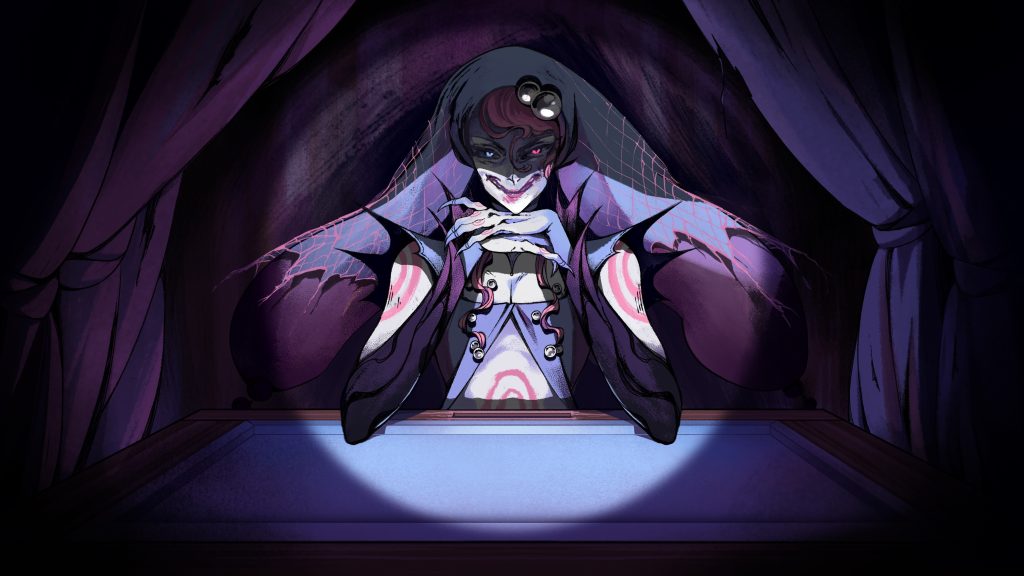
Rostaim: The visual identity of Carnaval Marbles really began with Mélanie Baptista, our Art Director, and a surprisingly collaborative process.
Rather than arriving with a finished visual concept, she interviewed each member of the team individually about the games, atmospheres, and artistic references we were drawn to.
I remember personally talking a lot about Child of Light and GRIS, two games that left a very strong impression on me. From there, she began developing the major illustrations, particularly Métis and the carnival itself. First through fairly simple sketches that she would show us before moving on to colour, almost using our reactions as part of the creative process.
At the time, I was working very closely with her on the narrative side, and a lot of the world-building documents I wrote fed directly into that early visual work.
Was Carnaval Marbles always intended to look and feel this way?
Rostaim: Interestingly, Carnaval Marbles was originally supposed to be much more narrative-driven.
The early premise imagined a version of Europe dominated by a powerful Church hunting anything that challenged its vision of the world. Monsters, mythological creatures, scientists, and other outsiders were all under threat, and the carnival had become a refuge for anyone who was different.
The idea was that you could potentially meet Dracula and Galileo in the exact same place.
Another early concept that survived directly into the final game is that each boss you defeat becomes a playable character. The creatures you first encounter as adversaries gradually become part of your own roster.
While a lot of the explicit narrative was eventually stripped back as we realised where the strengths of the gameplay lay, its DNA remains present in the art direction: the carnival acts as a strange, slightly dangerous shelter full of entities that don’t quite belong anywhere else.
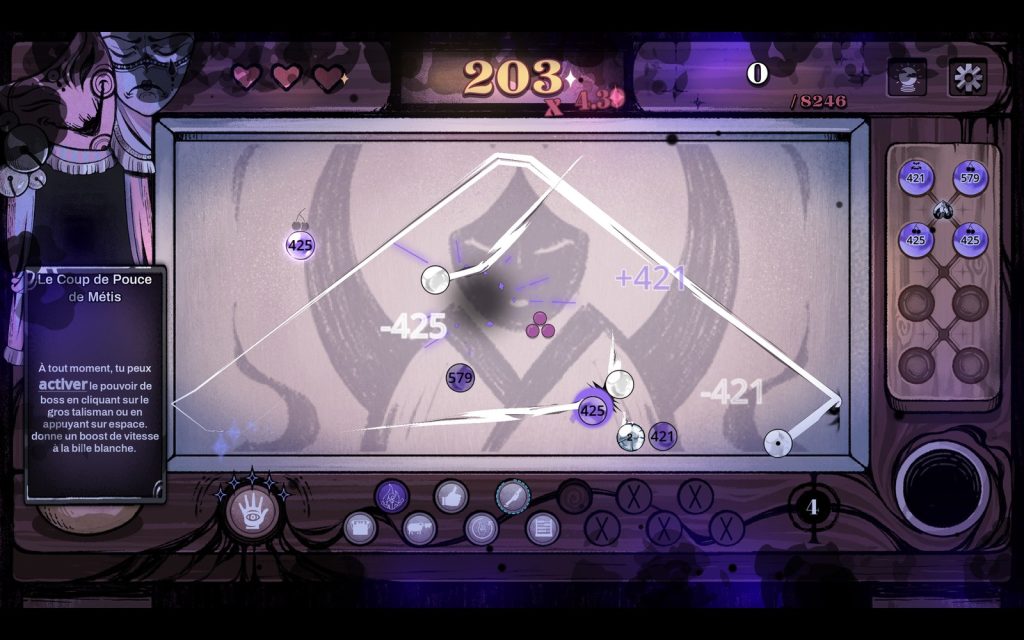
The interface has a very distinct, “handmade” texture. What went into designing the UI?
Rostaim: It’s funny because it looks handmade largely because it actually is! It grew organically during development rather than being designed as one pristine, unified UI system from day one.
The UI is a mix of Mélanie’s most ambitious, time-consuming illustrations combined with functional elements originally built directly in Godot by Benoit Jurado when he needed something working before final assets existed. Mélanie then gradually brought those pieces together into a coherent whole.
On top of that came additional illustrations from freelance artist Alix Maurin, alongside animation work by Mathéo DESTAMPES. Mathéo’s animations are rooted in a dark energy and fantasy-effect style that seamlessly complements the visual language established at the start of the project.
The final interface is a melting pot born out of art direction, development constraints, and thousands of hours of play testing. It may not always be perfectly uniform, but that’s precisely why it has a distinct texture that belongs specifically to this game.
The collaboration
How did the two studios come together to work on this project?
Rostaim: The collaboration is a little different from a simple split where “one studio did the art and the other did the mechanics.”
Summoning Systems grew out of a group of experienced software developers with particular expertise in 2D and 3D technologies. They eventually united under one company working across two sectors: industrial software projects and video games. Their first title was Last Hit Titan, an idle tower defence game.
Small Bang Studio was founded by Pierre Cattan in Paris in 2012. Historically, they worked on interactive productions, programs for Mediapart, and unusual cross-media projects. Video games are actually a very recent chapter in Small Bang Studio’s history, having found a place in the company only about a year ago.
Carnaval Marbles served as a genuine meeting point between two teams coming from very different creative backgrounds, rather than two studios simply handing off isolated parts to one another.
Gameplay, builds & procedural runs
How do build identities work through the Talismans and colour Systems?
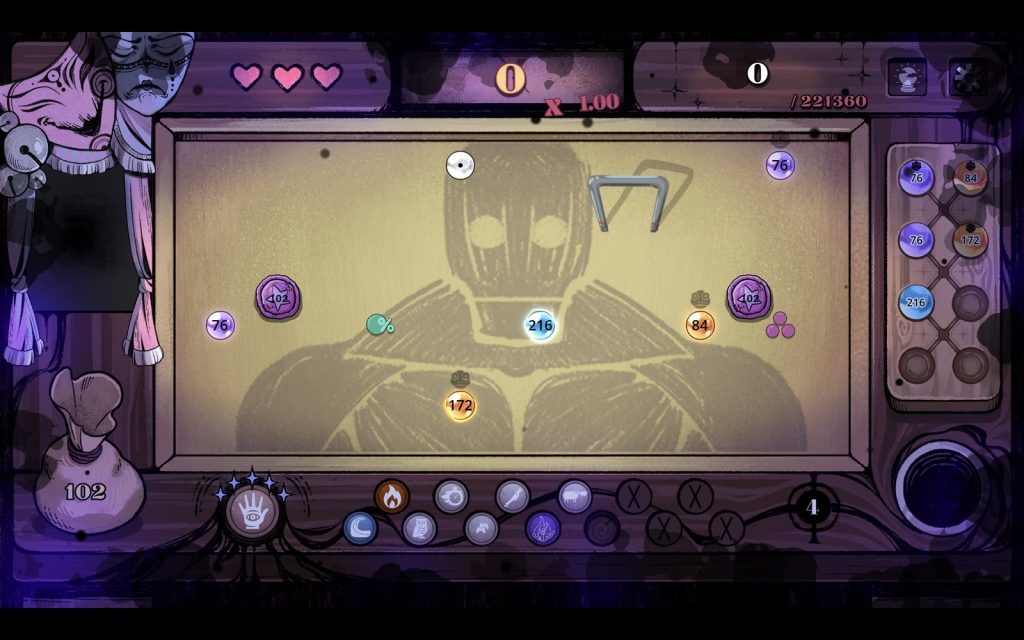
Rostaim: On the design side, a huge amount of work went into the Talismans and their colour families. Visually, the connection between individual Talismans and the carnival world is fairly loose. The colour system is what ties everything together visually and mechanically.
Each colour family carries distinct themes and mechanics:
- Yellow: Revolves around eggs and heavily interacts with table cushions.
- Blue: Associated with water and fluid mechanics.
- Purple: Draws on medieval imagery and introduces passive strategies. For example, Purple can spawn marbles that cannot be hit; instead, at the start of each round, they add their value to the other marbles on the table.
- Black: Plays directly with score reduction mechanics.
- Red: Designed to be approachable and intuitive for newer players.
Through hundreds of hours of testing, we realised players constantly look for key build pillars: speed (travelling further to trigger more marbles), indirect activations, raw score, multipliers, and bridge mechanics.
Ultimately, the most effective builds aren’t pure single-colour strategies. They emerge when players learn to weave systems from multiple colours together.
What keeps individual runs feeling unique?
Rostaim: Procedural variation happens naturally through layer accumulation rather than trying to reinvent the game on every run.
In any given run:
- Your starting colours and available card piles differ.
- Boss sequences, shop inventories, table bonuses, and active challenges rotate.
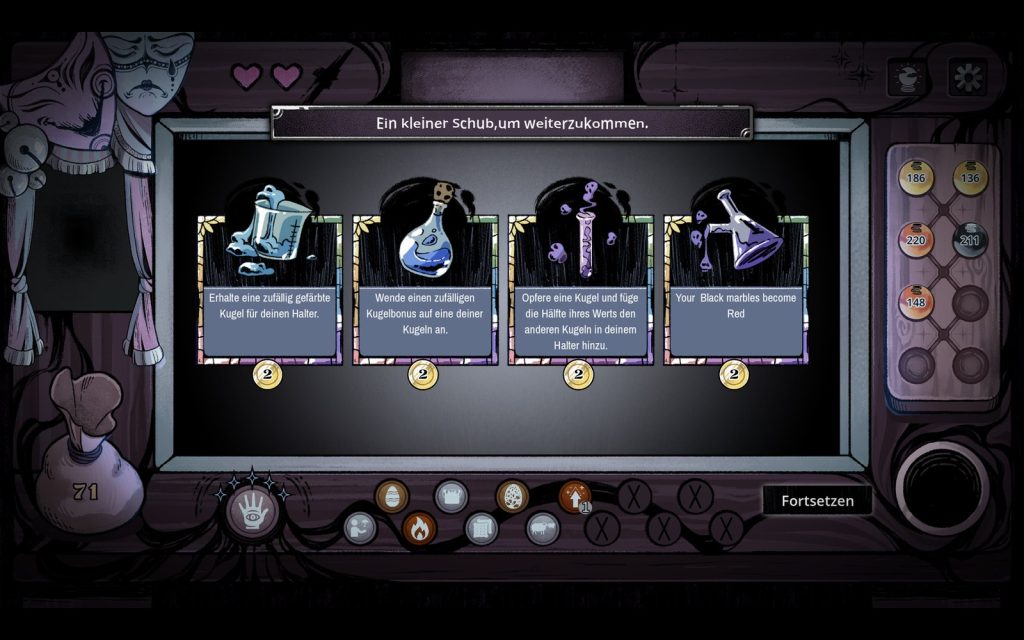
- Players choose 1 run item out of 4 distinct options.
None of these elements try to drastically alter the fundamental rules on their own, but accumulated together, every run develops its own identity. Meanwhile, the consistent dark carnival atmosphere, boss encounters, and dynamic lighting changes as you lose lives keep the core experience grounded.
Designing the bosses
What made designing bosses such a puzzle?
Rostaim: The eight bosses were easily our biggest design challenge because they serve a dual purpose: they act as threatening adversaries during a run, but once defeated, they become playable characters that you can embody.
We had to ensure that a boss’s mechanical identity as an enemy translates logically into their playable kit later on.
Another issue was balancing precision vs. scale. Early in a run, precise shots matter greatly. Later on, the player builds a complex “machine” of Talismans, multipliers, and chain activations around the billiards table. Bosses that relied strictly on extreme physical control felt frustrating late-game.
Our Solution: Boss constraints scale based on how many bosses you have already defeated in that run. A boss encountered early feels manageable, but that same boss fought last becomes a terrifying challenge.
Sound design
How did the audio style come together?
Rostaim: Our sound designer, Yann Lacan, created an audio profile that the entire team is incredibly proud of, and it’s consistently one of the highlights mentioned by players.
Yann has an incredible instinct for balance, knowing exactly how much variation a sound needs, when an audio effect takes up too much space, or when an action feels empty due to a missing micro-sound.
There’s also great trivia behind the audio creation: for the punching bag sound effect, Yann literally hit his head against his pillow, recorded it, and mixed it into the game!
And frankly, whenever Yann and I had a disagreement about audio direction, he turned out to be right every single time.
Looking ahead
If you could sum up the artistic identity of Carnaval Marbles in one sentence, what would it be?
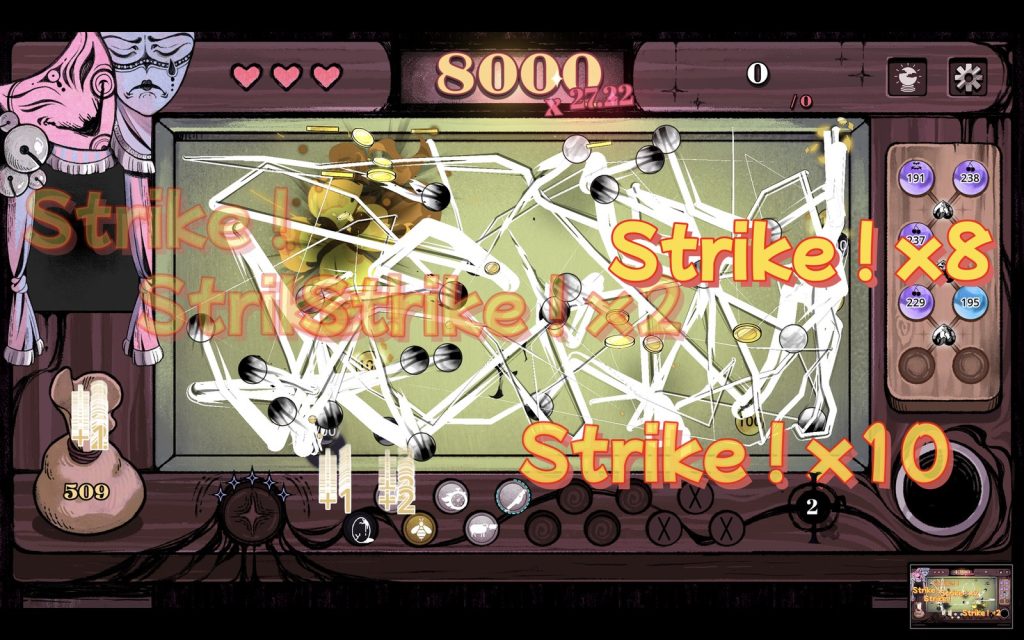
“Carnaval Marbles is a handmade dark carnival built around the clean geometry of French billiards, a world where precision slowly gives way to controlled chaos.”
What lies on the horizon for Carnaval Marbles?
Rostaim: We have plenty of experimental ideas we’d love to polish if the game continues to find its audience! We’re exploring new mechanics, a semi-random slot machine system, a four-leaf clover item, and even a brand-new colour family with its own gameplay mechanics.
If the game exceeds our expectations, bringing Carnaval Marbles to mobile is a major dream for us.
The initial spark for the whole project came from Pierre’s obsession with wanting to play French billiards on his phone during idle moments on public transport—something quick, tactile, and deeply re-playable. Bringing it to mobile wouldn’t just be a port; it would feel like the game finally returning to where its story first began.
Carnaval Marbles
On the face of it, Carnaval Marbles looks to be putting a really nice twist on the roguelite genre. We’re really excited to get stuck in. I, personally love a pool/snooker game and playing with angles and power, too. So it’s very enticing to me.
I’ll be working on our Indie-cent Exposure review over the next couple of weeks, making sure we give Carnaval Marbles as much time as possible.
For now, you should wishlist Carnaval Marbles on Steam, and get ready for the September 21st release!
Thanks so much to the team for engaging with us, we love shining a light on developers and studios, whenever we can!
Thanks for checking out this deep dive into Carnaval Marbles. If you’d like to check out more chats with game developers, head over to our Interviews section.