There is knowing the answer, and then there is knowing it quickly enough to actually earn any points for it.
Zip Blitz is built around that distinction.
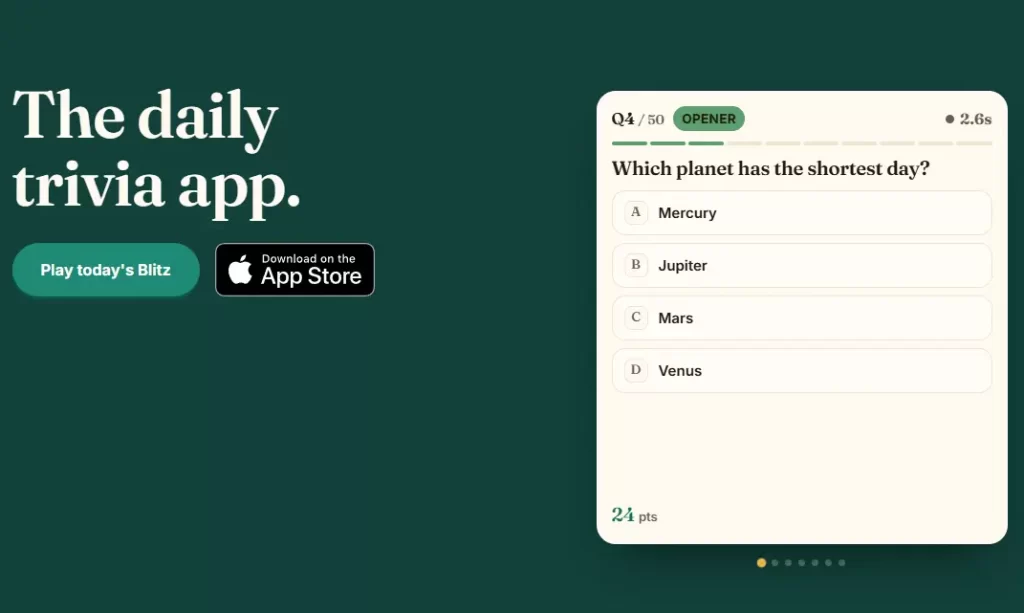
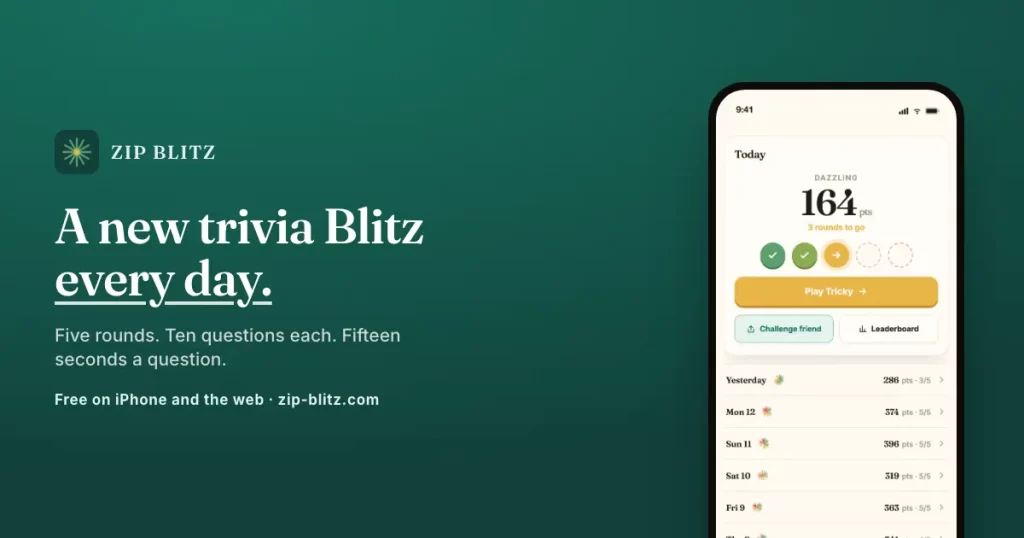
Created by George Burgess, the daily trivia game serves up five rounds of ten questions, with just 15 seconds to answer each one. The rounds become progressively nastier as you go, while the score keeps ticking down the longer you hesitate. Knowing that obscure capital city eventually is therefore considerably less useful than knowing it right now.
The social side is just as important. Players can challenge friends, build private leagues and even compete live against up to five other people, turning the familiar daily quiz into something much more competitive.
Zip Blitz is playable on the web and iPhone, with a fresh set of questions arriving every day. We caught up with George to talk about creating a trivia habit, making difficulty feel fair, building for friends rather than strangers, and how AI tools helped someone who does not consider himself a traditional programmer turn the idea into a working game.
To start us off, could you introduce yourself and tell us a little about your background? Where did Zip Blitz come from, and why was trivia the idea that ultimately stuck?
I’m a London-based founder who’s spent about 12 years in tech. I’ve always loved puzzle games – like the NYT games app – and thought it was time to try to create one myself.
At the beginning of this year, I started prototyping different game ideas using AI. I developed two very different games before Zip Blitz, but this proved to be by far the most popular with my early users, so I decided to focus all my attention on it.
Five rounds of ten questions is quite a bit more substantial than many daily games. How did you settle on that structure, and was the gradual climb from easier questions to the properly nasty stuff there from the beginning?
I’ve experimented with this a lot, trying to find just the right number of questions and rounds for Zip Blitz. I went from 15 questions down to 10, and from one round to three to five. Now it feels like the right length, and the user data seems to support this. It’s short enough to squeeze into your day, but long enough that you’re properly engaged.
Speed matters almost as much as knowledge because every second costs points. Why did you want hesitation to be punished in Zip Blitz, and does that create a different kind of tension from a traditional pub quiz where you have time to argue with yourself?
This was one of the most important features, and also turned out to be the most divisive! Rewarding speed adds tension and stress, so Zip Blitz feels different from other trivia apps. It’s definitely a lot more intense.
When I first created the app, you’d lose a point for every second you took. Now you get five seconds of grace, and only then do the points reduce. The other benefit is it also stops people from cheating by Googling the answer!
Writing 50 fresh questions every day sounds like a fairly relentless content machine. How do you source, check and balance them so the early rounds feel welcoming while the final ones are difficult without becoming obscure for the sake of it?
This has been tough! Thankfully, I now have a carefully refined set of AI prompts that do most of the heavy lifting, but I still do an editorial review myself. Surprisingly, the hardest piece of this was building a prompt that could reliably judge the difficulty of a question. Since AI knows everything, it struggles to differentiate between what’s “easy” and what’s “hard”.
Zip Blitz seems especially interested in competition between people who actually know each other, with challenges, leagues and live multiplayer. Why was beating your mates more important to you than simply building a giant anonymous global leaderboard?
There are hundreds of trivia apps out there, so I wanted to create something more engaging, more fun and (hopefully!) more viral. Social features felt like the right way to achieve that, and I’m certain it’s what’s kept my longest-playing users coming back: they see friends they know on the leaderboard every day.
With the speed and social components, the game definitely appeals most to very competitive people, so that’s the audience I’m focused on.
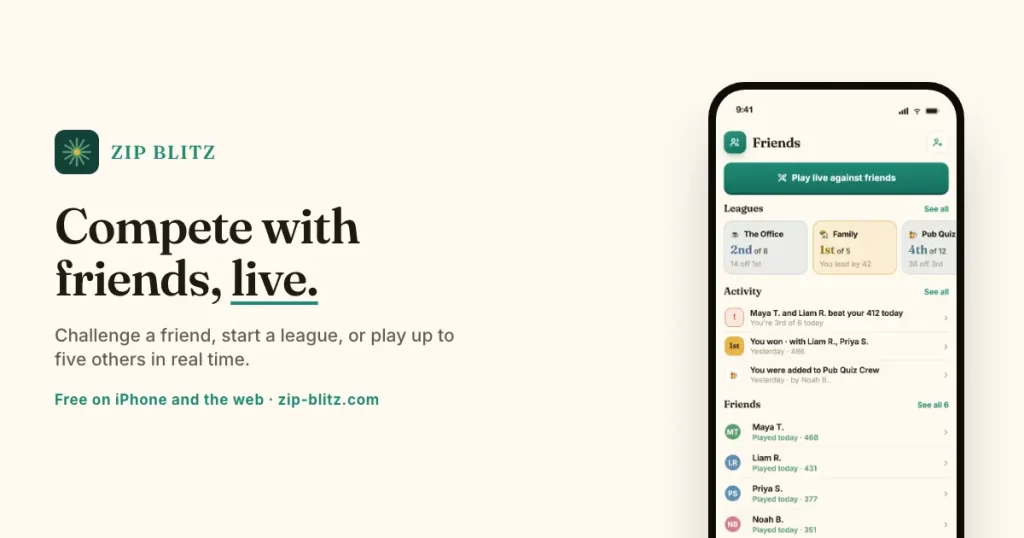
Live trivia with up to six people adds a very different pressure from doing the daily quiz alone. What have you learned from watching people play Zip Blitz together, and do otherwise sensible adults become unexpectedly unpleasant when bragging rights are involved?
Well, I haven’t seen any bad behaviour yet, but maybe it’ll come!
People seem to be using this feature as a way to pass the time in-person. I know groups who’ve used it around the table at the pub, whilst others use it at home with family. It introduces another level of excitement because you can hear everyone shrieking and squealing as they get things right or wrong, or run out of time!
The basic game is free, while Zip Blitz Plus adds extras around the tougher rounds, past quizzes and streaks. How do you decide what belongs behind the paid layer without making free players feel like they are only getting half the experience?
I’m still finding the balance. I want there to be enough free content that someone who would never pay can still love the app and share it with their friends. I think those advocates are really important for a game to take off.
You have spoken publicly about building your early game prototypes with Claude Code despite not being a traditional programmer. What did AI development tools allow you to do that would previously have required hiring a development team, and where do you still find that human judgement matters most?
I’m not a developer, but I have plenty of experience designing and creating products. AI coding tools are incredible for someone like me: I can bring ideas to life without having to commission a designer or developer. The cost of testing and developing ideas has basically dropped to zero, so I’m able to experiment with lots of ideas and see what sticks.
AI-assisted coding can dramatically lower the barrier to making something, but it can also create code somebody may not fully understand. How do you test, maintain and trust a growing app when parts of the development process are being accelerated by tools that can confidently get things wrong?
More AI! It’s about having other AI assess, test, review and challenge the code that gets written. Zip Blitz is built with over 5,000 internal tests to ensure the code is always working the way it should, and another AI runs the app through an iPhone simulator before every update to ensure it works as expected.
Finally, where do you want Zip Blitz to go from here? Is the ideal future simply a much bigger group of people arguing over daily scores, or do you see it growing into a broader collection of social trivia and daily games?
The goal now is to build awareness and grow the user base so it’s not just my early beta users on the leaderboard! I’ve spent over six months perfecting the experience, and it’s now ready for the world.
A big thank you to George Burgess for taking the time to speak with us about Zip Blitz.
Trivia is hardly a new idea, but adding a ticking score and making friends part of the equation changes the atmosphere surprisingly quickly. Suddenly knowing the answer is not enough. You need to know it before your mate does, preferably quickly enough that you can send them an irritating screenshot afterwards.
There is also an interesting development story sitting behind the quizzes. Tools that allow somebody without a conventional coding background to rapidly prototype and release a working game could open the door to plenty more small, strange ideas that might previously never have made it past someone’s notes app.
Of course, none of that helps when the final round asks something you absolutely should know and your 15 seconds are disappearing in front of you.
At that point, you are on your own.
Enjoyed reading this chat about Zip Blitz and fancy checking out some of our other game dev chats? Head over to our Interviews section.