
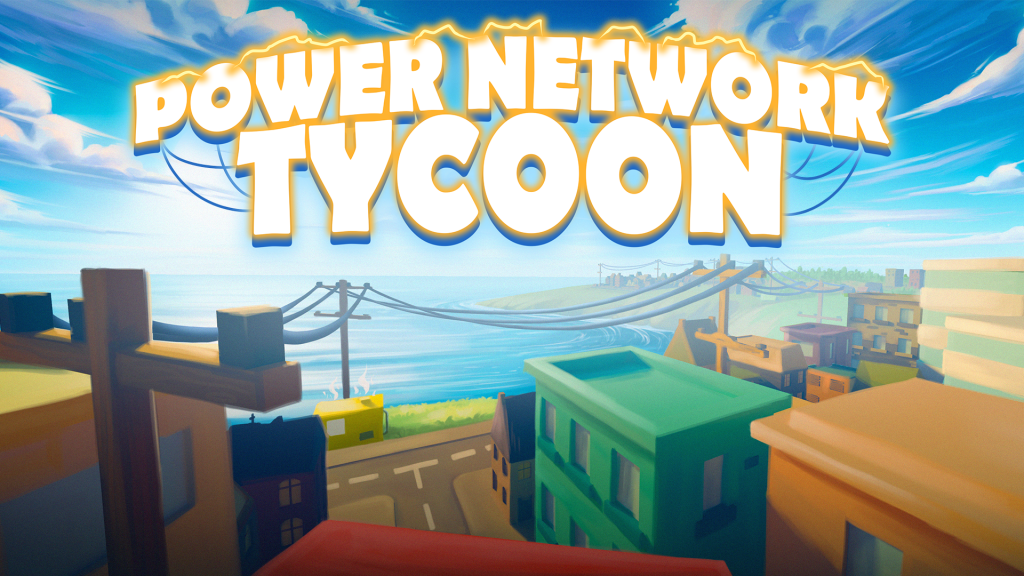
Plenty of city builders let you drop down a power station, connect a few cables and consider the electricity problem solved. Power Network Tycoon is considerably less willing to let you get away with that.
Created by Australian power engineer David McKenzie of David Made This, Power Network Tycoon takes the usually simplified business of keeping a virtual city powered and digs into what actually goes on behind the scenes. Supply and demand matter, infrastructure can fail, extreme weather can expose weaknesses, and apparently even things like ground potential rise and electromagnetic field strength are now problems we need to worry about while playing a tycoon game.
Thankfully, you do not need an engineering degree before Steam will let you install Power Network Tycoon.
That balance between genuine power-grid simulation and something ordinary players can actually understand has sat at the heart of Power Network Tycoon throughout its Early Access journey. After four years of development, that journey reaches a major milestone on 30 September, when the game moves into version 1.0 with further improvements accompanying its full release.
We caught up with David to talk about turning his day job into a game, why power networks deserve more than a simple electricity meter, the challenge of making real engineering fun, and what four years spent building a virtual grid have taught him about developing games alone.
Power Network Tycoon trailer
Before we start worrying about substations exploding in Power Network Tycoon, could you introduce yourself and tell us a little about your background? How does a professional power engineer in Australia end up spending four years making a power-grid management game?
I find the physics of electricity both really interesting and misunderstood, which led me to start a career along that path. I did a bachelor’s and master’s degree in electrical engineering, and also a science degree in mathematics and physics, and one area I really enjoyed was physics simulations. As a power engineer, you may throw some numbers together in a spreadsheet, but for anything beyond that, the equations from textbooks and academic papers can be hard to use.
Was Power Network Tycoon born out of looking at other city builders and thinking, “That really is not how electricity works”, or had you already wanted to find some way of turning your engineering experience into a game?
When COVID hit, I had a lot more time on my hands, and I wanted to use my time to improve my programming skills. I also enjoyed playing games such as engineering games (factorio/satisfactory) and city-building games (sim city/cities skylines), but like you say, they often were very shallow in engineering detail.
So Power Network Tycoon was an opportunity to combine the two together. I first tried turning some of the more complex maths into code to see if the performance impact is too much for a real-time game, and then added one system or visual at a time to make a game out of it.
Power generation is usually heavily simplified in management games: build enough capacity, connect it up, job done. What parts of running a real network did you feel games were consistently missing that you most wanted to represent properly?
There are a lot of areas like this, particularly because people’s perspective of a power grid is usually as a customer, where things are simpler.
One example is that my laptop has a 300-watt power charger, but for a power grid operator, they measure power with multiple values because the 300 value isn’t exact, as the load itself is complex. It’s fed a sine wave of current from the power grid but needs to chop that up into a shape for constant current for the computer. In doing so, it causes little distortions on the power grid, as well as the charger’s components periodically storing and releasing power.
This is the field of power quality, which I don’t think I’ve seen in games before, and all these little problems add up to a big problem for power grid operators.
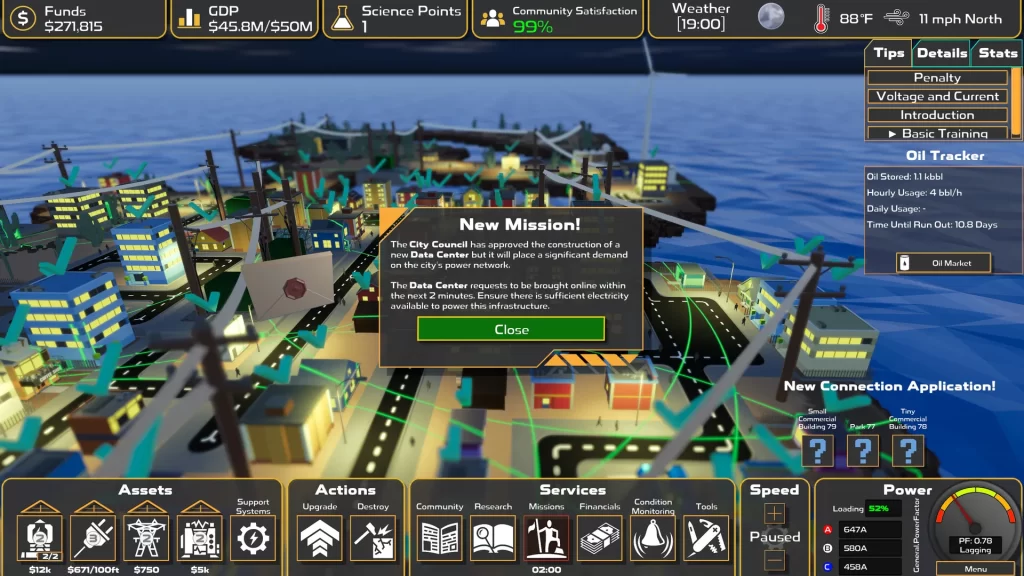
You describe the simulation as using calculations found in professional electrical-design software. There must be a point where realism stops being entertaining and starts becoming somebody’s engineering homework. How do you decide which real-world systems deserve to stay accurate and which need to bend for the sake of Power Network Tycoon?
I’ve certainly had to make some tough decisions about where to draw the line on realism and go for a level of simplicity both for the entertainment factor of the game and also so the market of interested players isn’t PhD students only. One approach I took for this was to make Power Network Tycoon fairly accurate but not have the player have to do too much.
For example, I reached out to an organisation called CIGRE, which is a Paris-based organisation, but they work globally on electrical equipment research and standards. They agreed to let me use some of their equations for power line thermal modelling. So Power Network Tycoon is very detailed in that way, and thermals also affect things like the resistances of power lines, which is important for runaway overheating and failing in-game.
The player doesn’t need to do anything complicated for the game to be more realistic in this way, but if they are interested, they can see some of the under-the-hood values from this.
Related to that, how difficult has it been to make something approachable for somebody who knows absolutely nothing about power engineering while still having enough depth that an actual engineer cannot immediately poke holes through everything?
I was approached by a company that does gamification of education, and around this time I knew the game was popular with engineering students, but I knew some parts would fly over the heads of others. I didn’t want this to be a showstopper for someone to enjoy the game.
All games have tutorials, but I then added a ‘Power Network Academy’ to the homepage, which is an interactive overview of the physics, without the maths, of how a power grid works with simple buttons and sliders. Focused on aspects related to the game but not how to play Power Network Tycoon; more about filling gaps in knowledge (also in the free demo version).
I do at times get feedback asking why a particular aspect of power grid management isn’t in it or isn’t extremely detailed, but the way I think about it is keeping it simple enough, without millions of buttons and text for the UI, so players can solve real-world problems.
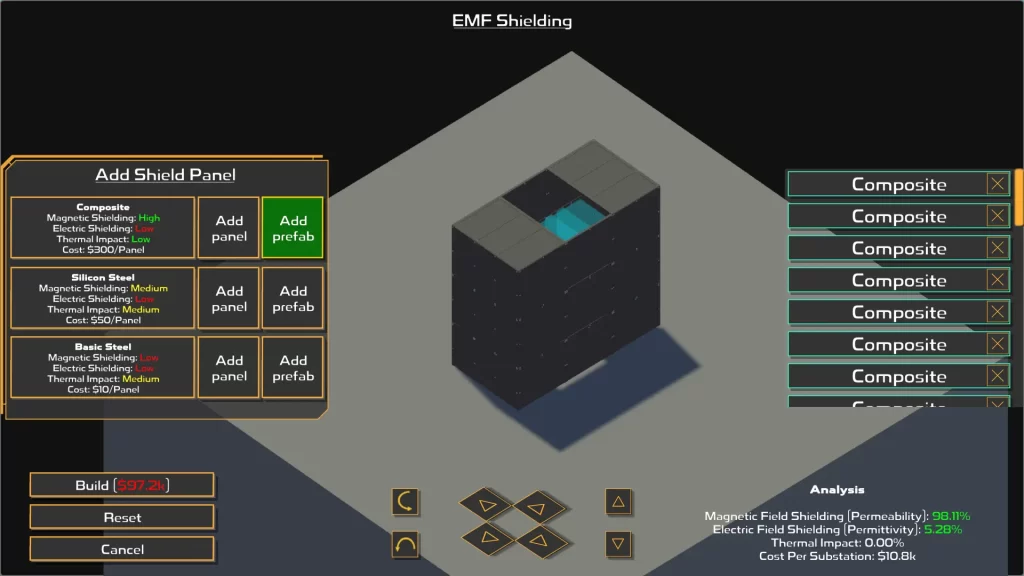
Some of the safety mechanics are unusually specific, including ground potential rise, electromagnetic fields and electrical overloading. What made you want player safety decisions to go that deep rather than simply representing failures as a generic breakdown or maintenance cost?
In the industry, safety is becoming increasingly important, and it’s an aspect of real-life engineering that, without including it, wouldn’t represent the decision-making an actual engineer goes through. It’s considered non-negotiable in a similar way to how the game’s missions come from the ‘Regulator’, so it’s a constraint you need to work with.
I think this is analogous to how most city builder games have you take a role more similar to a CEO or city planner. I was presenting at a conference recently on electrical safety, and one of the challenges talked about is the ‘if it ain’t broke, don’t fix it’ approach to spending money. The game certainly lets you take some shortcuts, but you then need to deal with the consequences afterwards.
For the entertainment factor, it has things like spending a Science Point on a ‘Technical Clarification’ community notice, which is defined as ‘Recent network issues were traced to rare external factors, not operator error. Convey a message of convincing technical content to clear any bad news’.
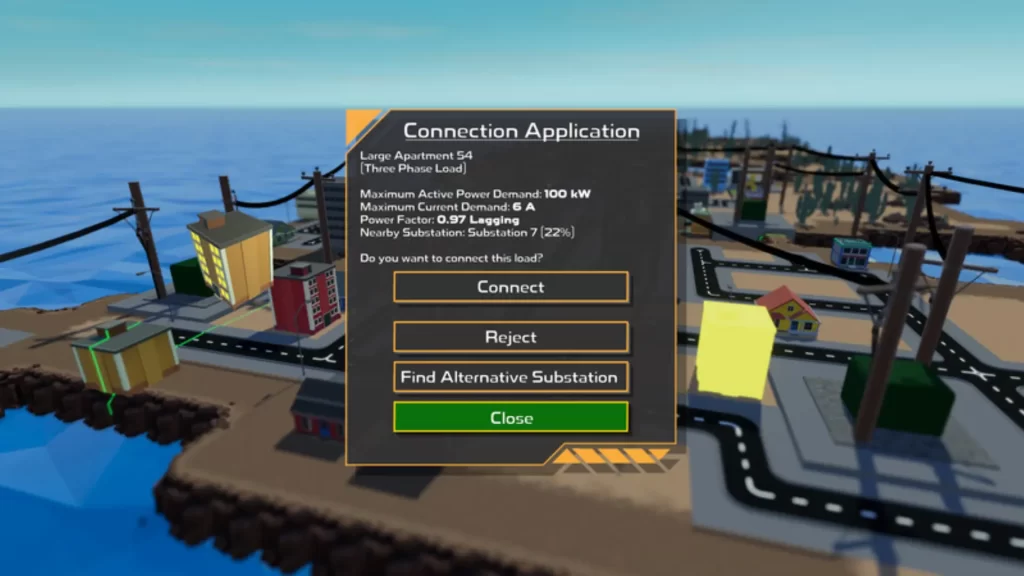
Has developing Power Network Tycoon highlighted any aspect of power infrastructure that you think the general public badly underestimates? Is there something happening behind the socket on the wall that you wish more people understood?
Probably how much work goes into making electricity seem simple. You turn on a switch and expect the power to be there, but behind that there are generators constantly responding to demand, equipment operating within limits, protection systems, maintenance and people planning for things going wrong.
One thing I wanted the game to show is that having enough generation isn’t necessarily enough. You still need to actually get that power where it needs to go without equipment overheating or other power quality problems.
Extreme weather also plays a major role, with storms and heatwaves putting pressure on the network. Given your real-world experience, how much of that system is based on problems power engineers genuinely have to plan around, and have any real incidents influenced scenarios in Power Network Tycoon?
Most of it comes from genuine considerations for power networks, although obviously exaggerated in places to make a game out of it. Temperature affects how much current a power line can safely carry, lightning can damage equipment, and wind can cause lines or structures to fail.
Some of the missions are also inspired by real events. One funny one is based on the UK, where after everyone finishes watching the latest episode of ‘EastEnders’, they all go to the kitchen to turn on the kettle, which causes an enormous jump in power demand for the grid (https://www.youtube.com/watch?v=slDAvewWfrA).
Failure seems particularly interesting in a grid because one bad decision can potentially create problems elsewhere rather than remaining isolated. How much scope is there for players to accidentally create cascading disasters, and are those moments secretly some of the most fun to design?
There is quite a lot of scope for that because the simulation is interconnected. If a power line fails, then its power has to go somewhere else, which can overload another line, causing that to fail and making the original problem even worse. In fact, a similar cascading of network failures occurred in New York in 2003. Those situations are definitely fun to design because I don’t have to specifically script the whole disaster.
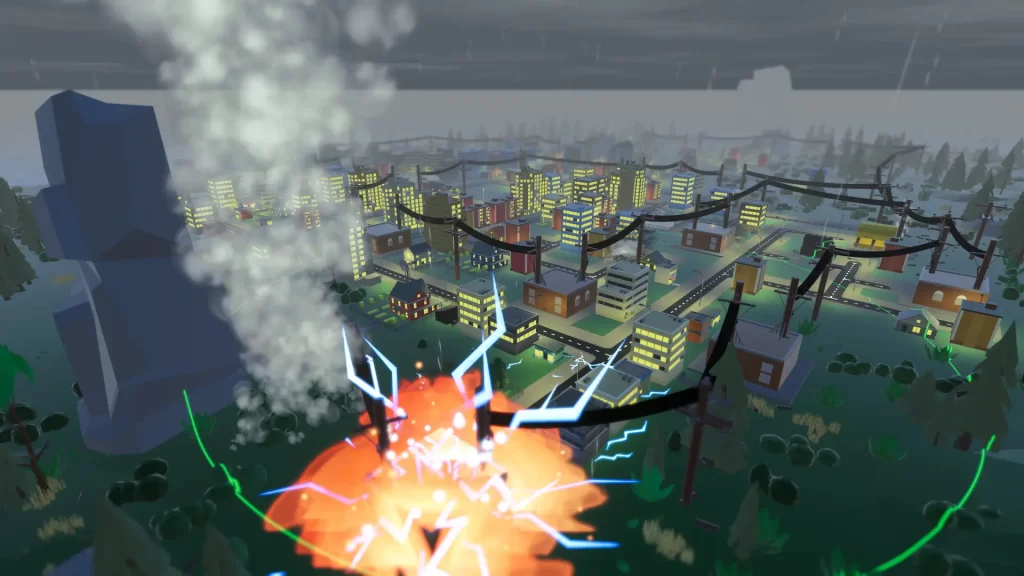
There is also an interesting tension between resilience and cost. The safest, strongest possible network is not necessarily the most financially sensible one. Is teaching players to live with calculated risk one of the more authentically “engineering” parts of Power Network Tycoon?
Definitely. Engineering is rarely about designing something with unlimited money and making everything as strong as physically possible. There are always constraints, and you need to decide where spending money actually provides value.
Power Network Tycoon lets you build a very redundant network if you want, but that costs money that could have been used elsewhere. Sometimes accepting that a particular failure is unlikely and dealing with it if it happens is the better decision.
You have had Power Network Tycoon in Early Access since 2024. Looking back at the version players first got their hands on compared with what will become 1.0, what has changed most dramatically?
Probably the amount of content surrounding the original power simulation. The fundamentals were already there in Early Access, but there are now far more things for the network to deal with, including weather, resources, oil, nuclear power, additional missions, research and endgame content.
I’ve also spent a lot of time on things that aren’t as obvious in screenshots, particularly performance, tutorials, UI and making complicated information easier to understand. The Power Network Tycoon demo also had a major rework to give players a longer introduction to what the game is about.
Early Access also means handing a technically complicated simulation to people who immediately find ways to break it that you never anticipated. What piece of player feedback has had the biggest influence on development, and has the community ever found a solution to a problem that surprised the engineer who built it?
The biggest recurring feedback on Power Network Tycoon was probably that the UI could become overwhelming. I knew what every number and button meant because I’d built them one at a time, while a new player sees everything at once. That led to quite a lot of redesign work and options for things like UI scale and transparency.
Players have definitely found network designs and ways of solving missions I hadn’t considered. That’s one of the benefits of having a simulation rather than puzzles with one intended solution, so it’s more open-ended.
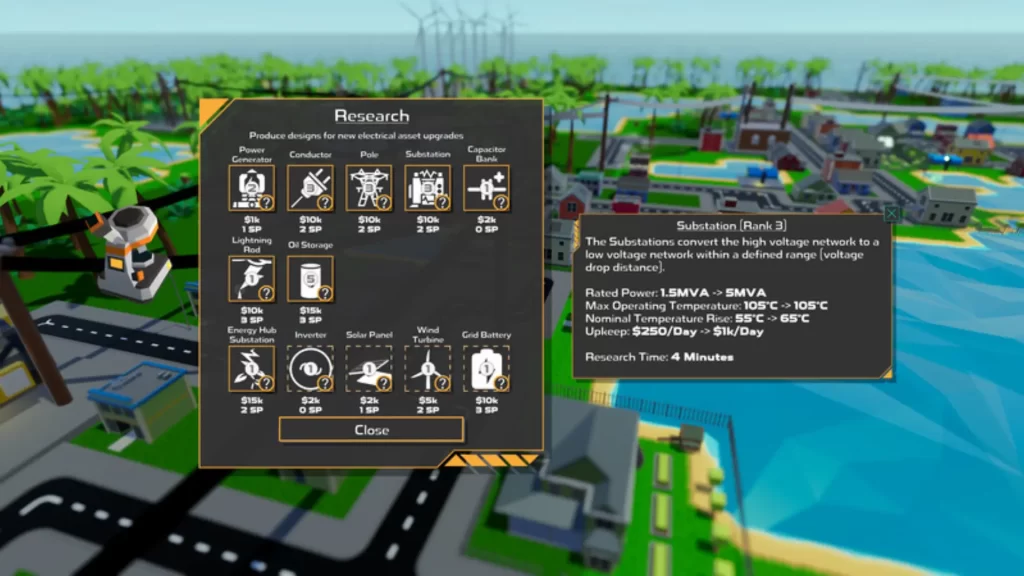
You are developing this independently alongside being a power engineer, and four years is a substantial commitment to one project. What has been harder: building the electrical simulation itself, turning it into an enjoyable game, or finding enough people to discover that the game exists?
The biggest challenge has been getting people to find it exists in the first place. The electrical simulation can be extremely difficult, but something I enjoyed problem-solving and could take my time with; but sometimes the marketing side is something requiring a lot more momentum to show it’s under active development.
You can also spend months working on something that you’re really happy with, but that doesn’t necessarily mean anyone will know it exists. That’s probably been the biggest learning curve for me.
You have built up more than 5,000 wishlists and a largely positive response ahead of Power Network Tycoon 1.0. For an independent developer working on a fairly specialised simulation, does that feel encouraging, or does approaching full release create a completely different kind of pressure around visibility?
It’s definitely encouraging because when I started this I wasn’t sure there would be much of an audience for something this specialised. Seeing people who aren’t power engineers enjoying it has probably been the most reassuring part.
There is definitely more pressure around the full release, though. I’ve spent four years being able to say Power Network Tycoon is still being developed, but with V1.0 I feel it needs to have that much higher level of polish and intuitive gameplay players expect.
Finally, when Power Network Tycoon reaches version 1.0 on 30 September, what will make you feel those four years were worthwhile? And perhaps more importantly, do you think someone could spend dozens of hours playing it and accidentally emerge knowing enough about power engineering to be dangerous?
For me, it already feels worthwhile when I see someone who knew very little about power engineering start understanding why something happened in their network and work out how to fix it. If someone enjoys Power Network Tycoon and learns something at the same time, then I’ve achieved what I wanted to.
As for being dangerous, with great power comes great responsibility. I guess if someone finishes the game and moves to playing other city builders, I don’t know if it’s better that they are relieved that the other game’s power grid is simpler or annoyed about it, but I know they will at least have a greater appreciation of the real world of power engineering.
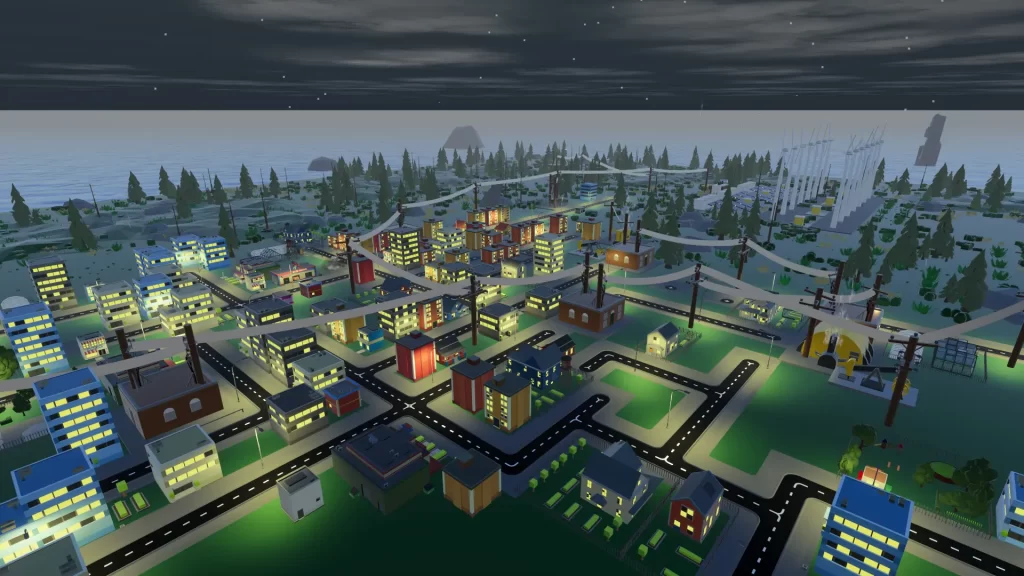
A big thank you to David for taking the time to speak with us about Power Network Tycoon.
There is something especially interesting about games made by people who genuinely know the subject they are simulating. Authenticity alone does not automatically make something fun, of course, but taking systems that are normally reduced to a few numbers and revealing just how much complexity is hiding underneath them can create an entirely different kind of management game.
Power Network Tycoon seems particularly committed to that idea. Building another generator is easy. Making sure electricity reaches everyone safely, efficiently and reliably while demand grows, equipment ages, and Mother Nature decides to ruin your afternoon is where things become considerably more interesting.
After four years of development and more than two years in Early Access, Power Network Tycoon reaches version 1.0 on 30 September. It will be available on Steam.
Just remember that when your entire island goes dark, blaming the engineer may be slightly difficult when you were the engineer.
Want to check out more game dev Q&As like this one about Power Network Tycoon? Head over to our Interviews section.






2 responses
Thanks for the interview! It was great having the opportunity to share my project and a bit about my passion for power engineering!
Appreciate you taking the time to answer our questions.