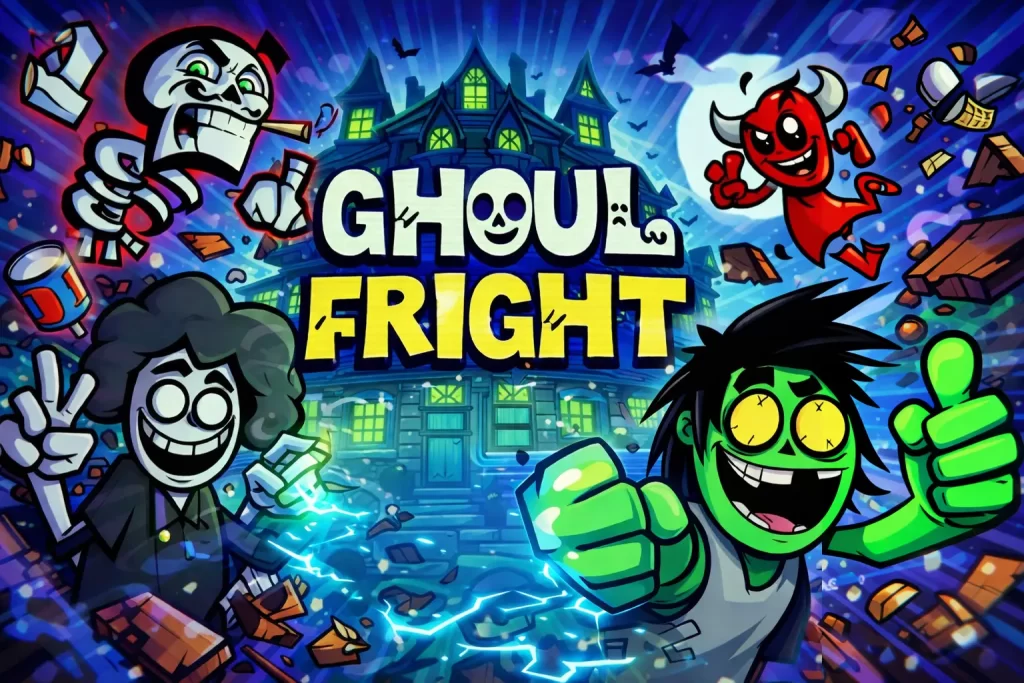
Ghoul Fright is not exactly trying to be subtle. It is loud, chaotic, ridiculous in all the right ways, and more than happy to throw players into a playground of fists, flying props, and increasingly unhinged waves of enemies. Between its physics-driven combat, survival structure, and 90s and 2000s cartoon-inspired energy, it feels like the sort of game that wants players to laugh, panic, and cause an irresponsible amount of damage all at once.
That alone makes it worth a closer look. Developed by Jaime Valls of Atrax, Ghoul Fright blends first-person action, beat ’em up brutality, and absurd horror comedy into something that looks determined to keep players on their toes. With deadly mafia skeletons, foul zombies, cursed waves, and a world that seems built to be smashed, grabbed, and weaponised, we wanted to dig into how all of that comes together without collapsing into total nonsense. We caught up with Jaime to talk about the game’s tone, its physics-heavy design, and what makes Ghoul Fright tick.
Quick Ghoul Fright update: Since we had this chat, the Ghoul Fright demo now has a playable co-op mode. So be sure to go and check it out.
To kick things off, could you introduce yourself and tell us a bit about your role at Atrax and how Ghoul Fright first came to life?
I’m Jaime Valls, and my role at Atrax has largely been to help turn the original Ghoul Fright prototype into a complete, focused game.
My involvement began when Dennis showed me what he had been working on. We have known each other for years, and even at that early stage, we could both feel that there was something special in the combat. It had an immediacy and a sense of impact that was genuinely satisfying. There was a little bit of magic there, and we knew it was worth developing further.
Over roughly the past year, we have been working together to understand exactly what made that prototype so enjoyable, then shaping the rest of the game around it.
Ghoul Fright has a very clear personality straight away. It is horror, but it is also silly, chaotic, and proudly over the top. At what point did you realise this game needed to lean fully into that cartoonish madness rather than play things more straight?
We realised it very early on because we quickly understood what Ghoul Fright was already good at. Its friendly cartoon aesthetic immediately stood out, and it felt like a style that had been missing for a while rather than something audiences had seen too often. Dennis grew up as a huge fan of Cartoon Network and its shows, so that visual language naturally became a major influence on Ghoul Fright. There is a nostalgic quality to it for people who grew up with cartoons from the 1990s and early 2000s, but it is also colourful, expressive and enjoyable for younger players.
That style also works perfectly with the game’s gratuitous violence. From a game design perspective, we did not want to create a sandbox filled with unrelated features that was not particularly good at any of them. We wanted to identify the game’s strongest qualities and build everything around them. For Ghoul Fright, those qualities were its cartoon presentation and its exaggerated, satisfying violence.
The further we pushed that violence, the better everything seemed to fit. Cartoon logic means that nothing needs to behave realistically. You can pick up a chair, throw it with absurd force, send everything flying and even have the chair explode. It does not feel disturbing; it feels spectacular, funny and satisfying, and immediately makes you want to do it again.
Once we recognised that reaction, we knew we had found our formula, so we decided to embrace it completely.
The game blends FPS action with beat ’em up-style combat, which is not a combination you see every day. What made that hybrid approach the right fit for Ghoul Fright?
That combination was actually what started the whole game. When Dennis showed me the prototype, you were fighting in first person and throwing punches, and there was immediately something special about it. It was unusual, it already worked, and we did not need to change its foundations. We simply needed to develop and improve what was already there.
Most games built around this kind of melee combat are played in third person. Using a first-person perspective makes everything feel more immediate, immersive and impactful. The enemies feel closer and more alive, as though they are genuinely coming for you, and every punch feels much more intense. At the same time, the cartoon presentation keeps that intensity fun and satisfying rather than oppressive.
It also allows players to notice details that are often lost when the character and camera are further away. One of the most important examples for us was the enemies’ eyes. Because they are so close to the player, you can see them watching you as they approach, and their gaze can change depending on their state or emotion. You can immediately tell whether they are focused on you, angry or about to attack.
That gives the enemies a surprising sense of life and personality. Their large, expressive cartoon eyes make their emotions instantly readable and create a kind of connection that you do not often experience in this type of game. For us, that combination of proximity, physical impact and expression is a major part of what makes Ghoul Fright feel so intense and distinctive.
One of the biggest hooks of Ghoul Fright is the physics-driven chaos, using the environment as a weapon, throwing props around, launching enemies, and generally turning the whole space into a violent toybox. How important was that sense of physical comedy and improvisation from the beginning?
It was essential from the very beginning. When we saw those brutal punches sending enemies flying across the room, the immediate reaction was simply, “This feels great”. From that point onwards, anything that strengthened that feeling was worth exploring. Finish a combo, and the enemy goes flying. Hit them with a chair, and they go flying. Set off an explosion, and everyone goes flying.
We knew that exaggerated physics worked perfectly with the cartoon style, so there was no reason to restrain it. The challenge was finding the right balance. Ghoul Fright is still a combat game with combos, blocking, and tactical decisions, and environmental objects need to complement those systems rather than replace them. We do not want the best strategy to be throwing chairs continuously. Objects should feel especially valuable in the right circumstances.
This becomes important when several enemies surround you. In first-person, that situation feels much more threatening than it often does in third-person games because you cannot comfortably see everything around you. That is when the environment becomes part of your strategy. You realise the fight is getting out of control, grab the nearest chair and create some space. You might throw an enemy through a window, use an explosive object or turn whatever is nearby into a weapon.
That improvisation gives the combat the feeling of a chaotic bar fight. When things start getting ugly, you look around for anything that might help. It is tactical, but it is also physical comedy, and that combination has always been fundamental to the game.
There is a real 90s and 2000s cartoon vibe to the whole thing. What were the main inspirations behind that look and tone, and what did you want players to feel the moment they first jump in?
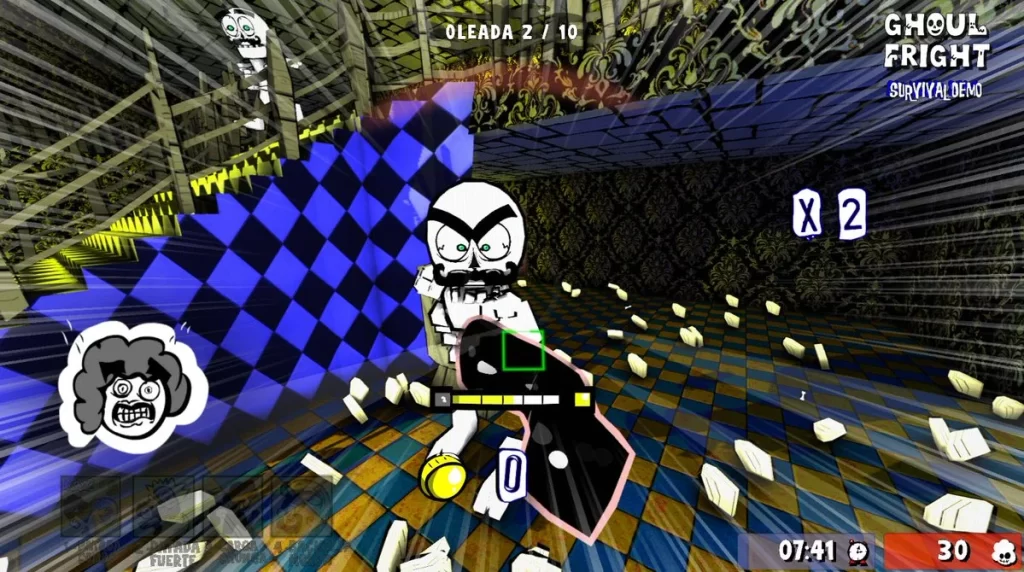
The main visual inspiration came from the Cartoon Network shows we grew up with during the 1990s and early 2000s. More specifically, Grabbed by the Ghoulies had a particularly strong influence on Dennis. He played it a lot when he was younger, and its style was an important reference when Ghoul Fright first began taking shape. If you look at the two games, you can probably recognise some of that influence.
As development continued, however, we started drawing inspiration from a much wider range of games. The combat has strong beat ’em up roots, particularly classics such as Cadillacs and Dinosaurs and The Punisher. Their approach to combos, attacks and managing groups of enemies helped inspire the kind of fighting experience we wanted to create.
At the same time, Ghoul Fright is fundamentally a survival game. Titles such as Left 4 Dead and Killing Floor have influenced certain mechanics and moments, especially the pressure of surviving against groups of enemies in first person. Those ideas also have a natural synergy with the multiplayer experience we are building.
When players first jump in, we want the visual style to feel immediately familiar and nostalgic, but the experience itself to feel fresh. It should be colourful, funny and inviting, then quickly become chaotic and intense once the enemies arrive. Ultimately, it combines the physical satisfaction of a classic beat ’em up with the pressure and cooperation of a first-person survival game.
Ghoul Fright sounds like it wants players to feel powerful, but also under pressure, especially with the wave-based structure and increasing difficulty. How did you approach balancing that line between empowering chaos and genuine survival tension?
Balancing that was one of our biggest challenges. We wanted the player to feel a little like a glass cannon: extremely powerful when everything is going well, but still vulnerable when they make a mistake. You can launch enemies across the room and create enormous chaos, but if a zombie grabs you or several enemies catch you in a combo, the situation can become dangerous very quickly.
Even weaker enemies are designed to demand some attention. They can block, react to your attacks and force you to change your approach rather than simply absorbing punches. When different enemy types appear together, players may need to reposition, use abilities or turn to environmental objects to regain control.
The story mode also becomes progressively more difficult. Enemies deal more damage, encounters become more demanding, and players need to equip themselves appropriately as they advance. If you neglect your equipment or fail to prepare for the harder levels, the difficulty can quickly become overwhelming.
The aim is to make players feel powerful without ever allowing them to become completely comfortable. You can dominate a fight, but one bad decision can still put you in serious trouble.
The enemy roster sounds brilliantly ridiculous, from farty strong zombies to mafia skeletons. How much fun did you have coming up with these creatures, and what makes an enemy concept feel right for the world of Ghoul Fright?
We had a lot of fun creating them, but every enemy also needed a clear purpose beyond simply looking ridiculous. The design had to fit our cartoon world while offering a distinct role in combat.
For the demo, we built the roster around three complementary archetypes. The zombie acts as a tank: it can absorb a lot of punishment and occupy the player while other enemies attack. The mafia skeleton is faster and stronger, with a wider range of attacks, so it fills more of a warrior role. Finally, the demon behaves like an assassin. It is weaker but extremely agile, avoids attacks and tries to get behind the player to deal greater damage or knock them down.
We will expand the roster with more enemies and variations, but that initial triangle gave us a strong foundation. Combining those roles makes encounters more interesting because each enemy creates a different problem and changes how the others behave.
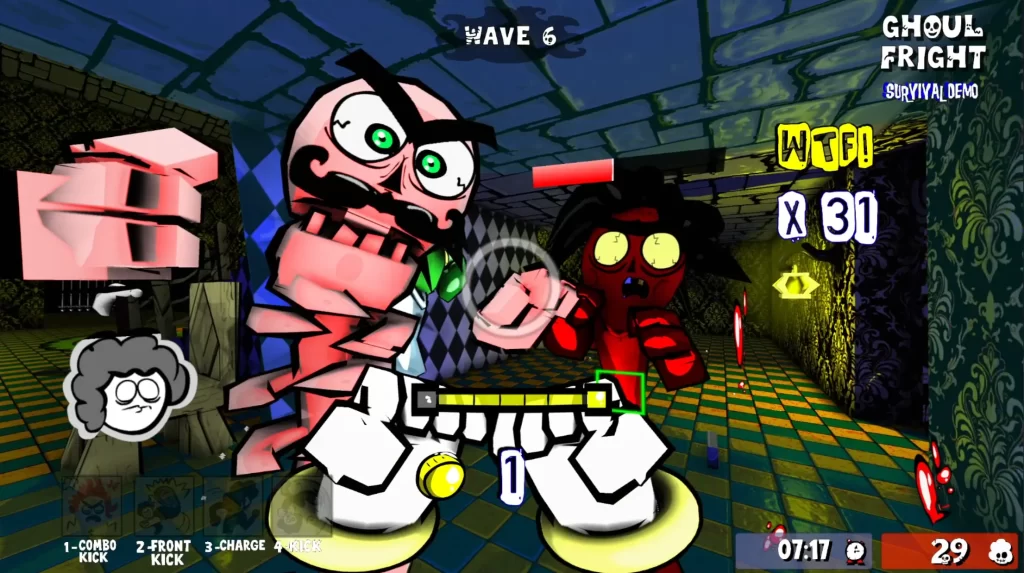
An enemy also needs personality to feel right for Ghoul Fright. Their abilities should suit their character, be clearly readable and produce exaggerated reactions. They shout, die dramatically and frequently cause chaos among themselves. Enemies can accidentally hit one another, become angry and start fighting between themselves. That friendly fire makes encounters funny and unpredictable, while also helping the battlefield feel like a real physical space rather than a collection of characters programmed only to attack the player
Bare-knuckle combat seems to be a huge part of Ghoul Fright’s identity, with punches, charged hits, grabs, stomps, and environmental violence all feeding into the flow. Was melee always meant to be the heart of the experience, or did that become clearer as development went on?
It became clear very early that melee needed to be the heart of the game. We have actually implemented several weapons, including a revolver and other ranged options, but they are currently on hold. Because Ghoul Fright is played in first person, placing too much emphasis on firearms would quickly turn it into a shooter, and that was not where we felt its real potential was.
The magic was already present in the combos and the physicality of the fighting. Throwing punches, grabbing enemies and feeling every impact was what made the original prototype exciting, so it made sense to concentrate on that rather than spread our attention across several different combat systems.
Since then, our focus has been on making first-person melee as responsive, varied and satisfying as possible. We wanted to develop something with its own identity, rather than simply creating another entry in an established genre.
We are very happy with where the combat is now. It feels distinctive, and we believe focusing so strongly on melee allowed us to preserve and strengthen what made Ghoul Fright special in the first place.
A lot of action games talk about letting players “cause mayhem”, but that can mean very little if the systems underneath are too limited. What have been the biggest challenges in making Ghoul Fright’s chaos feel reactive and satisfying rather than just noisy?
The biggest challenge was balancing several interacting systems without allowing any one of them to dominate the game. The enemy AI needed to make fighting a single opponent meaningful, while still working when five or ten enemies were attacking together. We also wanted to avoid an obvious strategy that players could repeat while ignoring everything else. The combat should constantly require them to read the situation and adapt.
We approached this by developing the game in layers. First, we focused entirely on the core combat and basic abilities. Once those foundations were balanced, satisfying and enjoyable on their own, we could begin introducing special abilities.
Those abilities add more variety and spectacle, but their cooldowns turn them into resources that must be managed. Players need to decide whether to use one immediately, save it for a dangerous enemy or keep it available in case they become surrounded.
Environmental objects follow the same principle. A chair may be useful against the first zombie you encounter, but it could be far more valuable later if the next room becomes chaotic and you need to retreat. The same applies to explosives and other limited opportunities within the environment.
That is what keeps the chaos reactive rather than merely noisy. Every additional system creates new choices, but none of them replaces or breaks the original combat. They all build upon the same strong foundation.
The structure of surviving three waves to beat the game is interesting, because it sounds simple on paper but also intense and focused. What appealed to you about keeping Ghoul Fright’s experience tight and immediate rather than stretching it into something much longer?
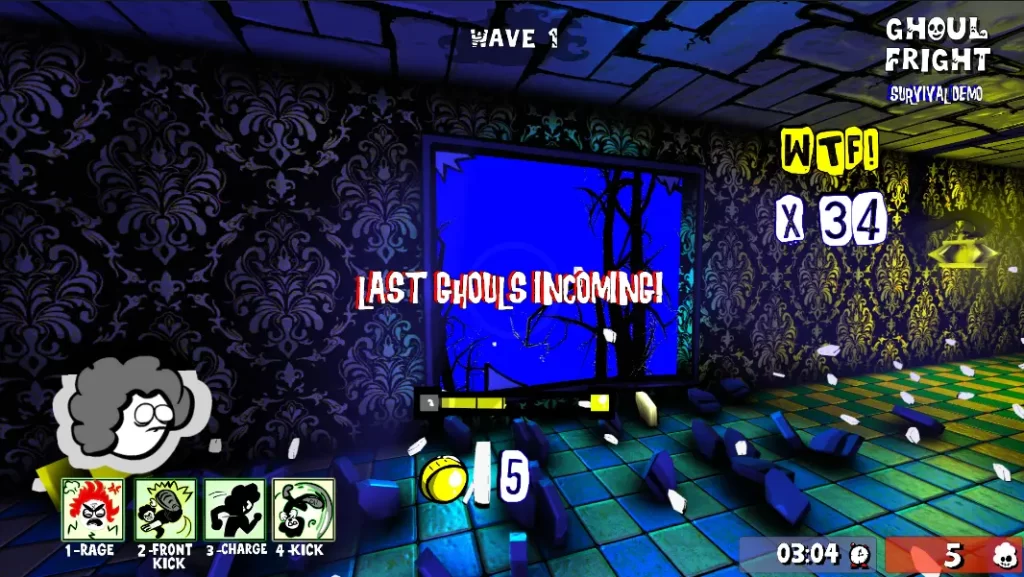
The current demo actually contains ten waves rather than three, followed by a final surprise. Three waves could be completed relatively quickly, so increasing that number gave the experience more room to develop.
Ten waves allow players to engage properly with the progression and economy systems we have recently added. They have time to collect items, improve their equipment and feel their situation changing as the run continues, while the experience remains focused and immediate.
We believe the core combat formula is strong enough to support a highly replayable structure. Rather than making each level unnecessarily long, we want to create more levels that players can return to repeatedly, with increasing difficulty, larger or more challenging enemy combinations and a greater need for effective equipment.
Part of the appeal is seeing how far you can survive as the pressure continues to build. It becomes a test of preparation and skill, both individually and against the achievements of other players. The aim is to create something easy to jump into, but difficult to master or completely overcome.
The cursed waves sound like a strong way of shaking things up and forcing players to adapt. What role do they play in keeping Ghoul Fright fresh, and how much do you enjoy making players slightly uncomfortable in the middle of all the absurdity?
Cursed waves were something we implemented early in development, and we liked the idea very much. They are currently disabled, but we plan to bring them back later as part of separate, temporary events.
We intend to keep the story mode as the main experience, with the game following its normal rules and progression. Cursed waves would exist outside that structure as special challenges, allowing us to introduce unusual modifiers without disrupting the balance of the main mode.
For example, an event could feature electrified zombies capable of shocking the player. Completing its challenges might reward you with special electrical equipment that could then be used in the story mode. This would give players a reason to engage with each event beyond simply surviving it.
Because these events would only be available temporarily, we could continue introducing new mechanics, enemy variations and rewards. That should help the game remain fresh while giving experienced players difficult and slightly unpredictable situations to overcome.
Comedy and violence can be a difficult mix to get right, especially when you also want the action to feel impactful. How do you make Ghoul Fright funny without undermining the tension, and brutal without losing the playful tone?
The first-person perspective helped us solve that balance quite naturally. The cartoon style allows the enemies, violence and physical reactions to be ridiculous, but experiencing everything at close range ensures that the combat still feels immediate and impactful.
One zombie might behave foolishly and go flying across the room in a way that makes you laugh. A moment later, another can land a heavy hit, knock you to the ground and force you to recover before returning to the fight. That sudden change reminds the player that, however funny the situation looks, the enemies are still dangerous.
We have built mechanics around those moments of vulnerability, including being knocked down and having to recover. They briefly interrupt your control, create tension and then give you a strong desire to get back into the fight and retaliate.
That contrast is central to the tone of Ghoul Fright. The cartoon presentation keeps the brutality playful, while the proximity and physical force of first-person combat prevent the comedy from removing the sense of danger.
As an indie developer, what has been the hardest part of bringing a game like Ghoul Fright together? Is it the technical side of the physics and combat, the challenge of landing the tone, or simply making something this energetic feel coherent?
The greatest challenge has clearly been the lack of resources. That is a familiar trade-off for independent developers: you have the freedom to follow your own vision without constantly having to justify every decision, but you have far fewer people and tools available to realise it.
We have been fortunate on the creative side. Our experience, clear direction and strong working relationship have helped us solve the design challenges without losing sight of what the game should be. The main limitation has simply been how quickly we can turn those ideas into reality.
With more people and greater resources, we could develop features, produce content and refine the game much faster. The freedom of being independent has allowed us to make Ghoul Fright distinctive, but the cost of that freedom is that everything takes more time and effort.
When players finish a run in Ghoul Fright, what do you most hope sticks with them: the ridiculous enemy types, the physical combat, the sheer chaos, or the feeling that they survived something properly unhinged?
More than anything, we want players to remember the satisfaction of the combat and the sense of power it gives them. Even if a run ends in defeat, the reaction should be, “I can do this”. They should understand what went wrong, feel that it was a small mistake and want to try again with the knowledge they have gained.
When players succeed, we want that satisfaction to become a desire for a greater challenge. They receive new rewards, improve their equipment and can move on to harder encounters with more enemies, greater damage, new enemy types and bosses.
A major part of that feeling comes from the number of decisions available during combat. Players have different abilities, counters, environmental objects and tactical options. Enemies may approach individually or as a group, attack from different directions or force the player to reposition and manage their resources differently.
The same encounter can therefore be solved in several ways, and a map should never play exactly the same way twice. That variety is essential to both the replayability and the enjoyment of Ghoul Fright. We want every run to leave players feeling powerful, satisfied and convinced that they could handle an even greater challenge next time.
Finally, what do you think Ghoul Fright says most clearly about you as a developer and about the kind of games you want Atrax to create?
I think Ghoul Fright shows that we want to create honest games that are clear about what they offer. It does not take long to understand what the game is about, and it aims to entertain the player from the very first moment with fast, direct and satisfying action.
It also reflects our love of retro games and animation. However, we do not want to reproduce the past without considering how games have evolved. Many design conventions from the 1980s and 1990s can feel dated or inaccessible to modern players.
For us, the interesting challenge is preserving the personality, nostalgia and creative energy of that era while combining it with responsive controls, immediate feedback and the satisfying gameplay that players expect today.
That balance between retro spirit and modern execution is what we believe defines Atrax. We want to make distinctive games that feel familiar and nostalgic, but are designed to be enjoyed now.
A big thank you to Jaime Valls for taking the time to speak with us about Ghoul Fright. It is always good fun coming across a game that knows exactly what kind of energy it wants to bring, and this one clearly is not interested in doing anything by halves. Between the cartoon style, the physical combat, and the gloriously daft enemy design, Ghoul Fright looks like it is aiming to be as entertainingly chaotic as possible.
What makes Ghoul Fright interesting, though, is that beneath all the absurdity there seems to be a real focus on feel. Ghoul Fright is not just about throwing silly ideas at the wall. It is about making those ideas playable, punchy, and memorable. That balance between nonsense and design is often where games like this either fall apart or really come alive, and it will be interesting to see how far Jaime and Atrax push it.
Enjoyed our chat about Ghoul Fright? Head to our interviews section to see some of the other indie devs we’ve chatted to about their games.