
Alpha Nomos is the sort of game that does not really get to hide behind vague marketing fluff. If you are going to pitch something as a rhythm-action roguelite where music shapes combat, power-ups, and the world itself, people are naturally going to want to know whether that idea is genuinely built into the game or just sitting there as a nice bit of wording for a trailer. From what we have seen so far, Alpha Nomos at least looks like it is trying to make that concept mean something.
Developed by RibCage Games, the game puts players in control of Cello as she fights through a ruined world full of murderous puppets, strange energy, and the lingering mystery of what music actually is within this setting. With an updated demo already out in the wild and more eyes now on the project, we wanted to dig into the thinking behind Alpha Nomos, from its rhythm-led combat and reactive soundtrack to the challenge of making a stylish idea feel great in players’ hands.
To kick things off, could you introduce yourself and tell us a bit about your role on Alpha Nomos and what part of the game you have been most closely involved with?
Hi, thank you so much for having me. I’m Itamar Berner, the CEO and co-founder of RibCage Games.
My role on Alpha Nomos is a bit of a balancing act. On the business side, I handle the operations of the studio and help guide our overarching creative vision. But honestly, my most important job is simply supporting our incredibly talented core development team – Emil, Amir, and Nataly. So they have the freedom to do their best work.
Alpha Nomos immediately stands out because it is not just using music as atmosphere; it is building combat and progression around it. At what point did you realise music needed to be a core system rather than simply part of the presentation?
Thank you, I really appreciate you saying that! Honestly, the realisation that music had to be the foundation of the game was there from the very beginning, all the way back to the 48-hour game jam where Alpha Nomos was first born.
When we started exploring the idea of blending an action roguelite with a rhythm game, we looked at the current market. We genuinely loved a lot of the games in the genre, but our collective feeling was always: ‘We like this, but we want more.’ We knew right out of the gate that we didn’t want music to just be a cool atmospheric backing track or a superficial gimmick. If music was only going to be part of the presentation, there wouldn’t have been much point in making the game at all.
Making music the core system is also what drove our biggest design choices later on, like ensuring our power-ups act as real audio effects that dynamically change the soundscape, or recording live instruments for our weapons. Because the music is the core system, every single run effectively becomes its own unique composition, shaped entirely by the player’s choices and skill.Rhythm mechanics can be brilliant when they click, but they can also put players off if they feel too rigid or punishing. How did you approach making Alpha Nomos feel musical without making it feel like players are being constantly tested by a metronome?
That is the exact trap we wanted to avoid. When rhythm mechanics get too rigid, you stop fighting the enemies and start fighting the UI, and it just feels like you’re taking a stressful metronome test.
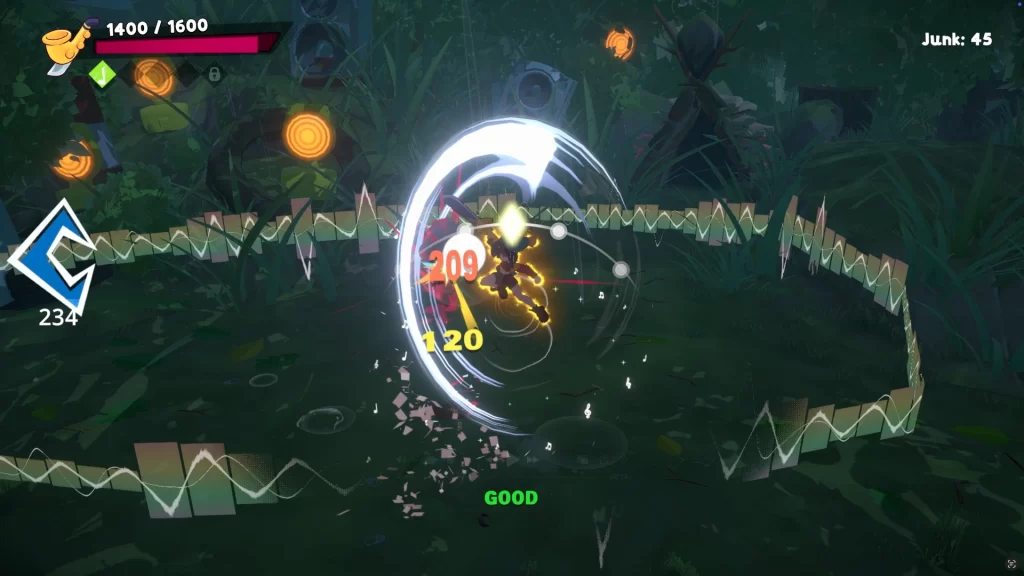
To solve this, we leaned heavily into our hack-and-slash roots. We deliberately chose not to ‘auto-snap’ player attacks to the beat. We wanted to keep that immediate, satisfying responsiveness of a classic action game where you are fully in control of your swings. Our tempo is our secret weapon here – it provides a very natural, comfortable groove that gives you space to breathe, react, and make tactical decisions without feeling constantly rushed by a ticking clock.
But more importantly, it comes down to how we frame the experience for the player. We didn’t build a system designed to heavily punish you for missing a beat; we built a system that massively rewards you for catching it. If you stumble, the game doesn’t instantly penalise you with a rigid fail state. Instead, as you naturally sink into the rhythm and start stringing together precise hits, your momentum, your flow, and the entire audio landscape elevate.
It all goes back to the idea of a jam session. If you miss a note while jamming with your friends, the song doesn’t just stop – you just find the pocket and jump back in. We built Alpha Nomos to give players the freedom to find their own rhythm organically, without the pressure of a strict metronome.
A lot of action roguelites talk about build variety, but Alpha Nomos seems to take that a step further by making power-ups affect not only how you fight, but also how you sound. How early was that “your fight, your soundtrack” idea locked in?
To answer your question, that idea was locked in incredibly early. Once we decided that music was going to be the absolute foundation of the game and not just a backdrop, the very next question we had to tackle was how to handle roguelite progression and power-ups.
If we had just given players standard roguelite upgrades like a flat ‘+10% damage’ or a ‘faster swing speed’ buff, it would have completely betrayed our core philosophy. We realised that if the player is essentially building a musical performance through their combat, then our power-ups needed to act like the effect pedals and amplifiers for their instruments.
We locked in the concept of using real-world audio effects – like Reverb, Delay, and Flanger – very early in development. It was definitely a massive technical challenge to make the game’s audio engine dynamically apply these effects to your attacks on the fly without it turning into a chaotic wall of noise, but we knew it was essential. We wanted players to reach the end of a deep roguelite run and realise that the completely unique audio signature they were hearing was a direct result of the specific tactical choices they made along the way.
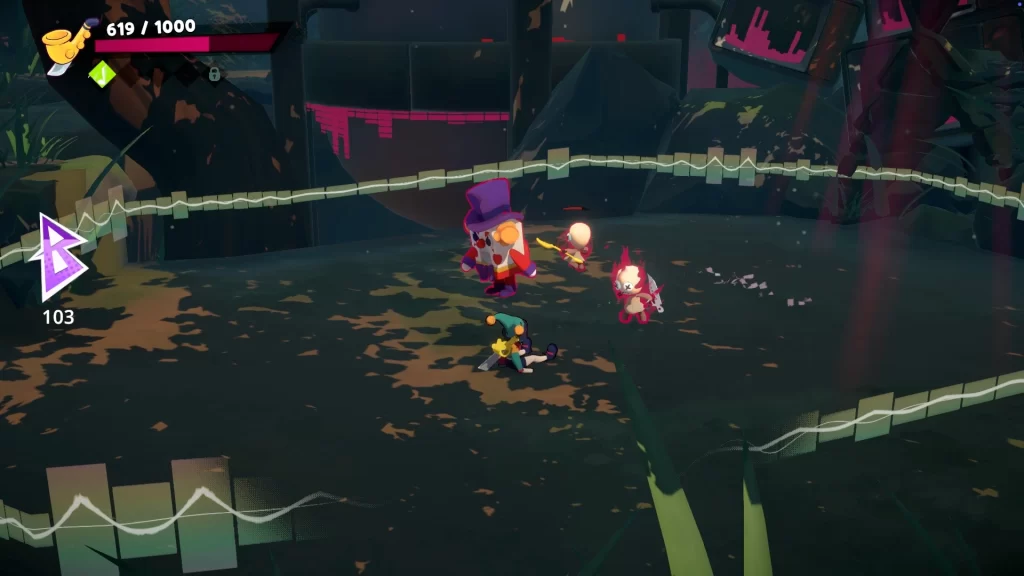
Cello is a strong hook as a protagonist, and the world around her seems full of unusual energy, both visually and narratively. What came first for you: the character, the setting, or the idea of music being this mysterious force at the centre of everything?
The music and the character came first, side-by-side – but the world and the lore evolved from the gameplay.
The mechanical foundation of music was the seed of the entire project. At that exact same time, Cello’s earliest design was born. She was initially a very different, bizarre jester creature.
But as we decided to push this into a full game, we realised we needed a narrative justification for why the world was pulsing with energy and why audio effects were changing the combat. That is when the setting and the lore really clicked into place. We thought: what if the characters in this world have absolutely no concept of what music actually is? What if to them, these giant speakers and instruments are just ancient, mysterious monoliths radiating a strange, corrupting energy?
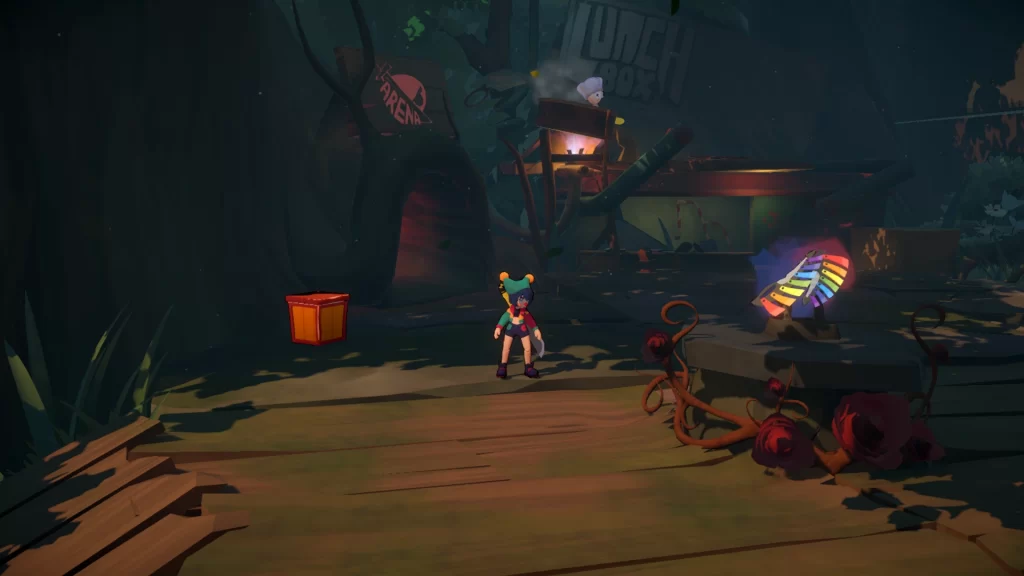
Once we locked in that idea – that music is a powerful, misunderstood force driving the world crazy – it perfectly bridged our gameplay and our narrative. It gave Nataly, our Creative Director, the perfect runway to build out those incredible, ‘cute-creepy’ environments like the Corrupted Forest and the Amusement Park. So while the mechanics and Cello sparked the initial idea, the setting and the mystery of the music are what truly brought the world of Alpha Nomos to life.
There is something really interesting about a world where “what is music?” feels like an actual story question rather than something we would normally take for granted. What excited you about treating music almost like a lost power or forbidden language within the game’s universe?
What really excited us about this concept was the opportunity to take something universally familiar to the player and make it feel completely alien and dangerous.
We all know what an amplifier, a saxophone, or a heavy drumbeat is. We take them for granted. But we thought: imagine encountering those things with absolutely zero context. Suddenly, a massive speaker isn’t just audio equipment – it becomes this strange, humming monolith radiating a mysterious energy. A heavy metal riff isn’t just a genre of music – it is a literal, physical force of nature that can corrupt the world around it.
Treating music as a lost power or a forbidden language completely flipped the script for us narratively. It creates this wonderful dramatic irony. The player sitting behind the screen is nodding along to the beat, recognising the Reverb and Delay effects, and fully understanding the ‘music.’ But Cello doesn’t.
To her, learning a new combo with the SaXword isn’t just practising a combat move; it’s like she is unknowingly deciphering an ancient, volatile magic. It makes her journey of exploration so much more compelling, because we get to watch her slowly tame and master this wild, chaotic energy that we, as players, already intuitively understand.
The enemy design also helps the game stick in the mind, especially with the idea of fighting murderous puppets in a world that feels broken but still expressive. What kind of tone were you aiming for with Alpha Nomos overall, and how did you keep it from tipping too far into either silliness or self-seriousness?
That balance was genuinely one of our biggest artistic challenges. If a rhythm-action game is too self-serious or brooding, it completely betrays the fun, expressive ‘jam session’ feeling of the gameplay. But if it tips too far into being a silly, slapstick cartoon, the stakes disappear, and the intense roguelite combat loses its punch.
To keep it right in the middle, we anchored everything to that ‘cute-creepy’ vibe I mentioned earlier, which is heavily inspired by our Creative Director Nataly’s love for classic Soviet stop-motion animation.
The secret to making it work was creating a massive contrast between the lore and the visuals. Narratively, the stakes are very serious. The world is broken, and this mysterious, volatile force known as ‘music’ is literally corrupting the environment and driving its inhabitants crazy, turning them into these murderous, hostile puppets. It is a post-apocalyptic scenario.
But visually, we refused to make it bleak. We kept the colours vibrant, the animations highly expressive, and Cello herself dressed in fun, adventurous gear with bells on her hat. The enemies might be trying to kill you, but they are doing it with a weird, theatrical charm. It mirrors the dual nature of music itself: music can be incredibly heavy, intense, and dark, but fundamentally, it is still an expression of creativity and joy. We wanted the tone of Alpha Nomos to reflect both sides of that coin.
Rhythm-based combat often lives or dies on feel. During development, what have been the hardest things to get right in terms of timing, responsiveness, and making players feel clever rather than constrained?
If a rhythm-action game doesn’t ‘feel’ right within the first ten seconds, you have lost the player.
During development, the absolute hardest thing to get right was the tension between animation weight and rhythmic timing. In a standard hack-and-slash, the pace of combat is dictated by the animation frames – when you swing a heavy sword, it takes a moment to connect because it needs to feel weighty. But in a rhythm game, the beat dictates the pace, and players expect instant auditory feedback when they press a button.
Getting the heavy, intricate combo links of the SaXword or the rapid, chainsaw-like flurries of the Xyloblades to fit perfectly into our tempo without feeling clunky or delayed took months of gruelling iteration. We had to tune the input windows so carefully. Because we explicitly chose not to use ‘auto-snap’ to force players onto the beat, we had to figure out exactly how forgiving those input windows needed to be. We want you to feel the groove without demanding robotic, frame-perfect precision.
As for making players feel clever rather than constrained, that all comes down to player agency and our audio power-ups. If the game just tells you ‘press X on the beat,’ you are just following instructions. But when a player realises they can intentionally hold back for a half-second, deliberately drop a heavy attack right on a major downbeat, and trigger a massive Reverb or Delay effect that wipes out a crowd – that is when the magic happens. They don’t feel like they are constrained by a metronome; they feel like a musical genius who just composed the perfect combat solo.
The updated demo suggests the game has been actively refined as more people get their hands on it. What have players been responding to most strongly so far, and has any feedback genuinely shifted the way you think about the game?
The community response to the demo has been incredibly humbling. By far, the thing players are responding to most strongly is that ‘Aha!’ moment when the dynamic audio truly clicks. It usually happens a few runs in, when they grab a power-up, hit a massive combo with the SaXword, and suddenly realise they aren’t just listening to a backing track – they are actively composing the combat music in real-time. Hearing players excitedly talk about ‘their’ specific soundtrack at the end of a run has been incredibly validating for our core concept.
But to answer the second part of your question: yes, player feedback has absolutely shifted our perspective, specifically regarding emergent gameplay.
When we first built the combat system, we designed very specific, intentional ways we expected players to engage with the rhythm. But once the demo was out in the wild, players immediately started experimenting. Because we chose not to rigidly lock attacks to a strict metronome, players started discovering and executing these wildly creative, unintended musical combat techniques that we hadn’t even planned for.
That completely shifted our design philosophy. Instead of trying to patch out those unintended quirks to force players to play ‘our way,’ we realised that this emergent creativity was the true magic of the game. It completely reinforced our goal of making Alpha Nomos a true ‘jam session.’ Now, when we design new weapons or encounters, we actively try to leave space for players to break the rules and invent their own rhythm techniques. The community essentially taught us to trust their creativity.
Steam Next Fest feels like a natural fit for something like Alpha Nomos, because this is clearly the kind of game people need to play rather than just read about. How important was it for you to get the demo in front of players in that setting?
Participating in Steam Next Fest was absolutely crucial for us. When you read the phrase ‘dynamic audio power-ups’ on a Steam page, it sounds like a cool feature. But when you are actually playing the game – when you feel the combat pulsing to the beat, when you intentionally hold back a swing to drop a massive attack on the downbeat, and you hear the Delay effect literally echoing your actions through a crowd of enemies – that is a feeling that translates instantly. It is a completely visceral, sensory experience that a trailer simply cannot fully capture.
Beyond just showcasing the game, Next Fest was the ultimate stress test for our ‘fail early, fail often’ philosophy. We needed to open the floodgates. We needed to see how the game felt in the hands of hundreds of players with completely different rhythmic backgrounds- from hardcore hack-and-slash veterans to people who struggle to keep a beat.
Getting the Alpha Nomos demo in front of that massive, diverse audience gave us the raw, unfiltered data and feedback we needed to refine that exact ‘game feel’ we’ve been chasing. It proved to us that the core loop works, and it gave us the exact roadmap we needed to make the final release even better.
Stylish games can sometimes win attention quickly but struggle to hold it if the systems underneath are not deep enough. How do you make sure Alpha Nomos has the substance to match its presentation?
That is an incredibly valid concern, and it is the exact trap we were determined to avoid from day one. It’s easy to make a game look and sound cool in a ten-second trailer, but to keep a player engaged for twenty or thirty hours, the systems beneath the hood have to be rock solid.
For Alpha Nomos, ensuring our substance matches our presentation comes down to two major design pillars: mechanical depth and tactical roguelite progression.
First, we built our combat system to have a massive skill ceiling. We treat our weapons like fighting game characters. If you pick up the SaXword, you aren’t just mashing an attack button; you are learning intricate combo links. If you wield one of our unrevealed weapons, you are diving into a system built entirely around high-level combo optimisation. We designed this game for players who love digging into mechanics, ensuring it is easy to pick up, but incredibly hard to truly master.
The world itself seems to react to the music players create, which gives the game a sense of performance as well as combat. How important is that idea of the environment feeling alive and responsive, rather than just functioning as a backdrop?
If the environment was completely static, the music would just feel like a soundtrack slapped over a standard video game. But in Alpha Nomos, music is a literal, physical force of nature. For that to feel true, the world absolutely had to reflect it. We wanted the environment to feel alive, breathing, and almost volatile.
We don’t want players staring at a UI bar or a ticking clock in the corner of the screen to find the rhythm – we want their eyes on the action.
Indie development often means balancing the big exciting vision with the reality of time, budget, and what is actually achievable. What has been the biggest challenge in getting Alpha Nomos to a point where it feels like the version of the game you really want people to see?
For Alpha Nomos, the absolute biggest challenge was the technical scope of our dynamic audio system. Our big, exciting vision was that every player’s run would sound completely different based on their build, utilising high-quality, live-recorded instruments and real-world audio effects.
On paper, that sounds amazing. In reality, figuring out how to dynamically layer effects over a live saxophone recording, sync it perfectly to a strict tempo, and maintain the split-second responsiveness of a hack-and-slash action game without the audio turning into a chaotic, garbled mess was a monumental mountain to climb. We didn’t have the budget of a AAA studio to just throw unlimited engineers at the problem.
There were definitely times when the vision felt a bit too big for us. As a studio, we had to heavily rely on our mantra of ‘fail early, fail often.’ We completely tore down and rewrote our combat loop countless times to get the feel right.
The key to finally getting the game to a point where it matches our vision was brutal prioritisation. We had to accept that we didn’t need to launch with a hundred superficial power-ups; we just needed a tightly curated selection of incredible ones – that offered deep, meaningful evolutions. Releasing the demo and seeing players actually experience that polished, dynamic audio loop for themselves was the moment we knew we had finally bridged the gap between our ambition and our reality.
For players discovering Alpha Nomos for the first time, what do you most hope sticks with them after a run: the feel of the combat, the music-system interplay, the world and its mystery, or something else entirely?
It is genuinely hard to pick just one, because our ultimate goal is for all of those elements to melt together into a singular experience. But if I had to choose the one thing I most hope sticks with a player after a run, it is that feeling of reaching a true, musical flow state.
We don’t just want players to put down the controller and think, ‘Wow, I survived a really tough roguelite run.’ We want them to feel the exact same adrenaline rush you get when you step off a stage after an incredible jam session.
The mystery of the world, the tight responsiveness and the dynamic audio – those are all just the instruments and the stage we provide. The magic happens when a player finishes a run, hears that final delayed, reverberating note ring out, and realises, ‘I just composed that.’ We want them to walk away remembering that in Alpha Nomos, they weren’t just playing a game; they were putting on a completely unique performance.
Finally, as the game pushes on towards full release, what part of Alpha Nomos are you most excited for players to experience that the current demo only hints at?
The demo is really just the tip of the iceberg of Alpha Nomos, and we are so excited to finally take the training wheels off for the full release.
Mechanically, I am most excited for players to get their hands on the full arsenal of weapons we have been keeping under wraps. The demo gives you a great taste, but we have an entire roster of instruments that completely change the way you interact with the rhythm.
Beyond that, the sheer scale of the dynamic audio is something the demo only hints at. In the full game, when you start stacking heavily upgraded, hyper-evolved versions of these power-ups during late-game runs, the soundscapes you create are absolutely wild. It stops sounding like a solo practice run and turns into a massive, high-energy live concert.
Finally, I can’t wait for players to dive deeper into Alpha Nomos’s narrative. The demo sets the stage and asks the central question: ‘What is this mysterious, corrupting force of music?’ The full release is where Cello really starts uncovering the answers. The way that mystery unfolds through the environments and our major boss encounters is something our entire team is incredibly proud of.
A big thank you to the team at RibCage Games for taking the time to speak with us about Alpha Nomos. It is always encouraging to see a game commit this hard to a central idea, especially when that idea could so easily have been treated as surface-level flavour. The more we hear about Alpha Nomos, the more it feels like a project that genuinely wants music to shape the player experience rather than simply decorate it.
There is still more to prove, of course, but that is part of what makes it interesting. Alpha Nomos has style, identity, and a clear mechanical hook, and now it is a matter of seeing how fully those things come together in the finished game. Either way, it is definitely one we will be keeping an ear on.
Fancy checking out more of our game dev interviews? Then click right here.