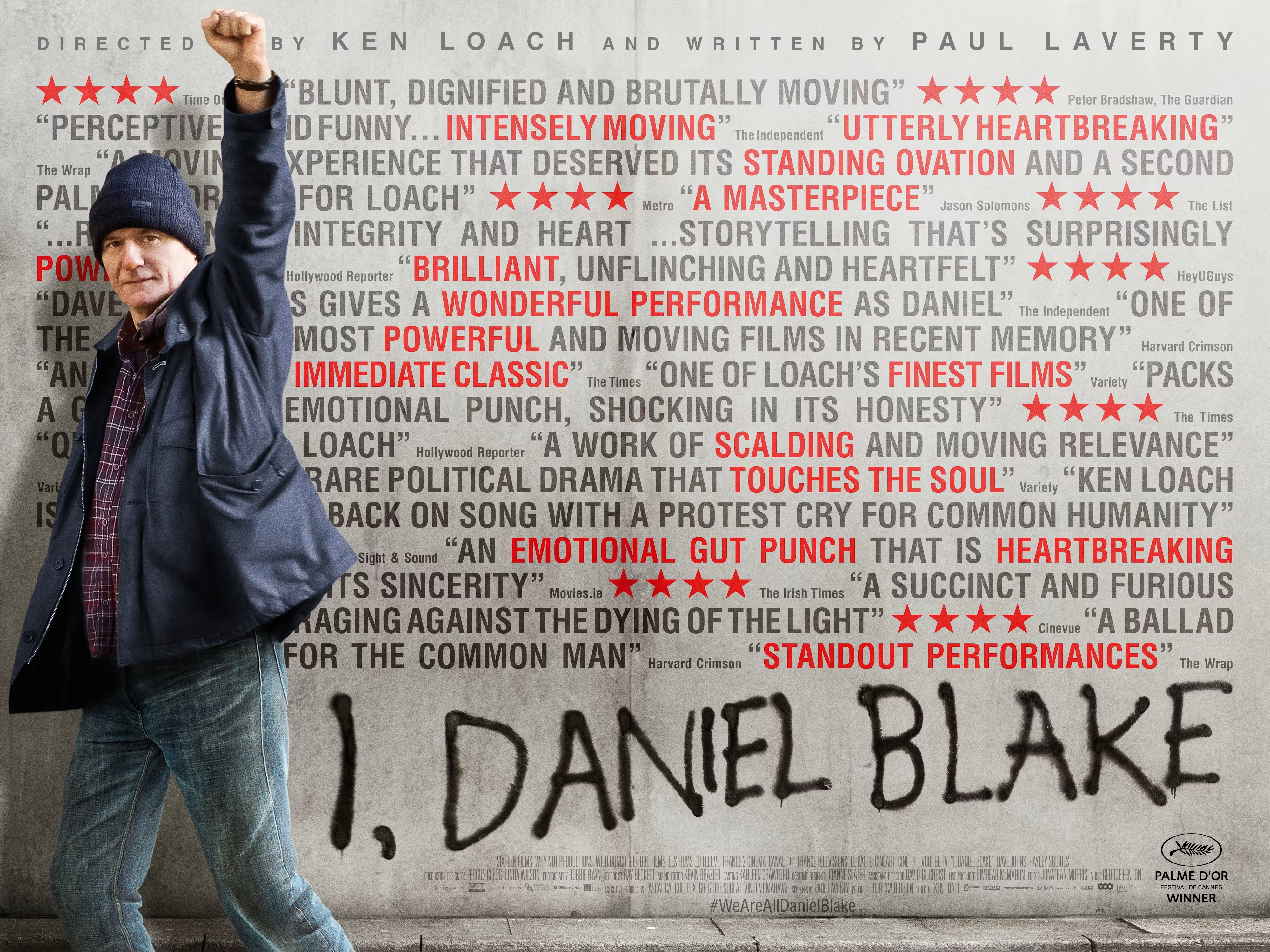
Some films do not need monsters to be horrifying; I, Daniel Blake is one of those films.
There are no killers lurking in the shadows. No supernatural twists. No grand spectacle. Just a man who has worked all his life, suffered a heart attack, and suddenly finds himself forced to navigate a system that should be there to help him, but instead seems built to wear him down until there is nothing left.
That is what makes it hit so hard.
Watching it now, years on from release, it still feels painfully relevant. If anything, that might be the most depressing thing about it. I, Daniel Blake is not a story that feels trapped in 2016. It still feels current. Still feels believable. Still feels like the sort of thing that could happen to someone down the road, someone in your family, or even you if life takes a bad turn at the wrong moment. It’s that same realism we felt when we watched and reviewed Dragonfly a couple weeks back.
It understands how exhausting it is to ask for help
What I, Daniel Blake gets so right is the sheer grind of it all.
Daniel is not presented as someone trying to game the system. He is not lazy. He is not looking for an easy life. He is a working-class man who has done what society asks of him for years, only to find that the minute he needs support, the rules suddenly become more important than the reality in front of them.
That side of I, Daniel Blake feels brutally honest.
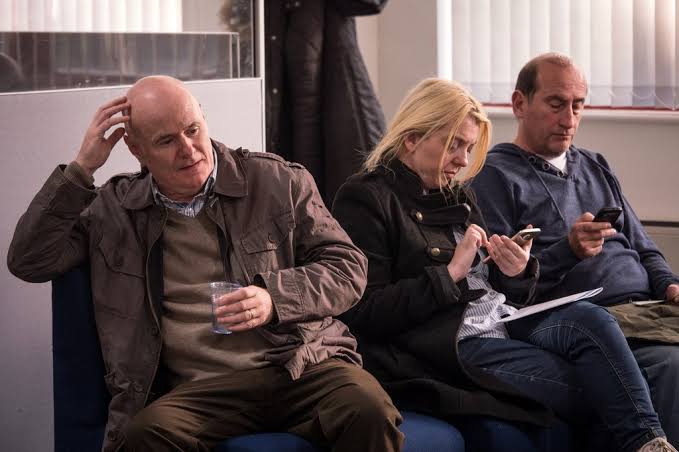
Anyone who has ever had to deal with welfare bureaucracy, or watched someone else do it, will probably recognise at least some part of this. The forms. The hoops. The strange disconnect between actual need and whatever arbitrary boxes some system wants ticked. The feeling that the people making the decisions do not really see you as a person at all, just a problem to process and push along.
That is where the film really gets under your skin. Not by shouting. Not by being melodramatic. But by showing how exhausting and dehumanising it can be when a support system stops acting like support.
Dave Johns is incredible because he never overplays it
A lot of what makes I, Daniel Blake work comes down to Dave Johns.
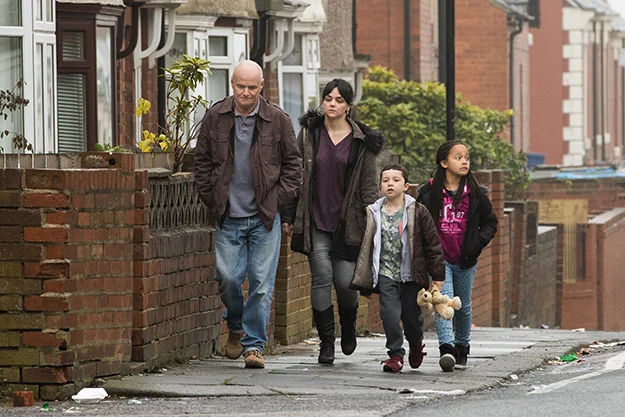
Daniel is proud, stubborn, decent, frustrated, and quietly falling apart under pressure, and Johns plays him in a way that never feels exaggerated. He is believable from the start. He feels like someone you know. The sort of man who has probably spent most of his life getting on with things, not asking for much, and not really knowing what to do when the world suddenly starts treating him like a burden.
That pride matters.
Because it is not just a story about money or paperwork. It is also about identity. About what happens when someone who has spent their life working and providing is suddenly told to sit still, stay quiet, and accept being processed by a machine that does not care who they are. Daniel’s struggle is practical, yes, but it is also emotional. His sense of self is being chipped away at the same time.
And Johns carries all of that brilliantly.
The friendship at the centre gives it warmth as well as pain
For all the anger and sadness in I, Daniel Blake, it is not misery for misery’s sake.
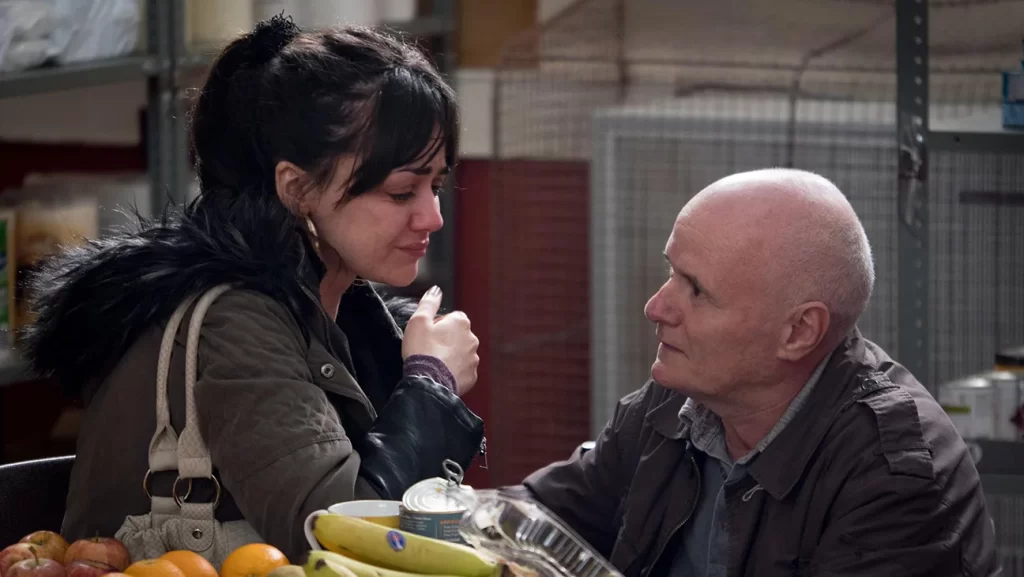
The relationship between Daniel and Katie, the single mother he befriends, is a huge part of why the film works as well as it does. She is battling her own way through the same indifferent system, trying to hold things together for her children while being shuffled around and pushed into circumstances nobody would choose.
Their bond is where the film finds much of its heart.
There is a genuine tenderness to the way they look after each other, even while both are carrying far more than they should have to. Daniel, for all his own problems, keeps putting other people first. He sees what Katie and her children need and tries to fill the gaps where he can. It says a lot about who he is, but it also says a lot about the wider point the film is making.
When the system fails, people are left relying on each other instead.
That creates some of the film’s nicest moments. It is not all relentless despair. There is humour here. Warmth too. A sense of connection that keeps the whole thing from becoming unbearable. Those small moments matter because they remind you what is worth protecting in the first place.
I, Daniel Blake is angry, but never in a cheap way
Ken Loach has never exactly been shy about where he stands, and neither has Paul Laverty, but what makes I, Daniel Blake so effective is that its anger feels earned.
It is not trying to score easy points by turning everyone into a cartoon villain. The real villain here is the system itself. The coldness of it. The way it strips people of dignity. The way it turns obvious human need into a technicality.
That is far more unsettling than if the film had just settled for a few nasty individuals and called it a day.
You can feel the frustration in every part of it, but it is controlled frustration. Focused frustration. The film knows exactly what it wants to say, and it says it without losing sight of the people caught in the middle.
Why it still lingers
That is probably the biggest compliment I can give it. I, Daniel Blake lingers.
It is not just a film you watch, nod at, and move on from. It hangs around. It keeps circling back in your mind. Not because it is trying to be shocking, but because it feels true in ways that are hard to shake. Even if your own experience has not been as desperate as Daniel’s, there is something recognisable in the helplessness, the pride, the bureaucratic nonsense, and the feeling of having to fight far harder than you should for basic humanity.
And once the emotional weight of it starts building, it does not really let go.
It is heartbreaking, yes, but it is also important. The ending lands because by that point the film has made you understand exactly what is at stake, and exactly how much damage can be done by systems that stop seeing people properly.
Final thoughts on I, Daniel Blake
I, Daniel Blake is not subtle, but it does not need to be.
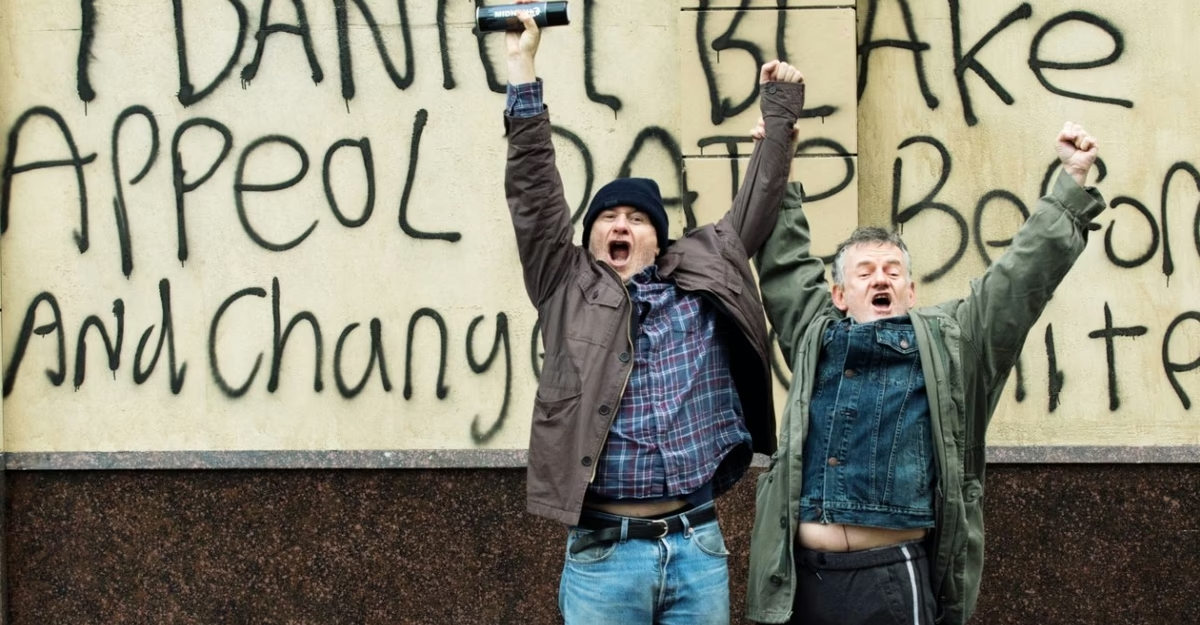
It is a deeply human film about welfare, pride, friendship, and a society that too often makes life hardest for the people least equipped to fight back. The performances are excellent, the writing is painfully sharp, and the anger running through it never overwhelms the people at the centre of the story.
What makes it so powerful is that it does not feel like a historical snapshot of a bad moment that has passed. It still feels relevant. Still feels urgent. Still feels like a warning people have not properly listened to.
And that is why it remains such a cracking watch, even if “watch” feels too light a word for something this heavy.
I, Daniel Blake is an emotional rollercoaster, a brutal portrait of a broken system, and one of those films that stays with you long after the credits roll.
For more content on indie films like this I, Daniel Blake review, click right here.