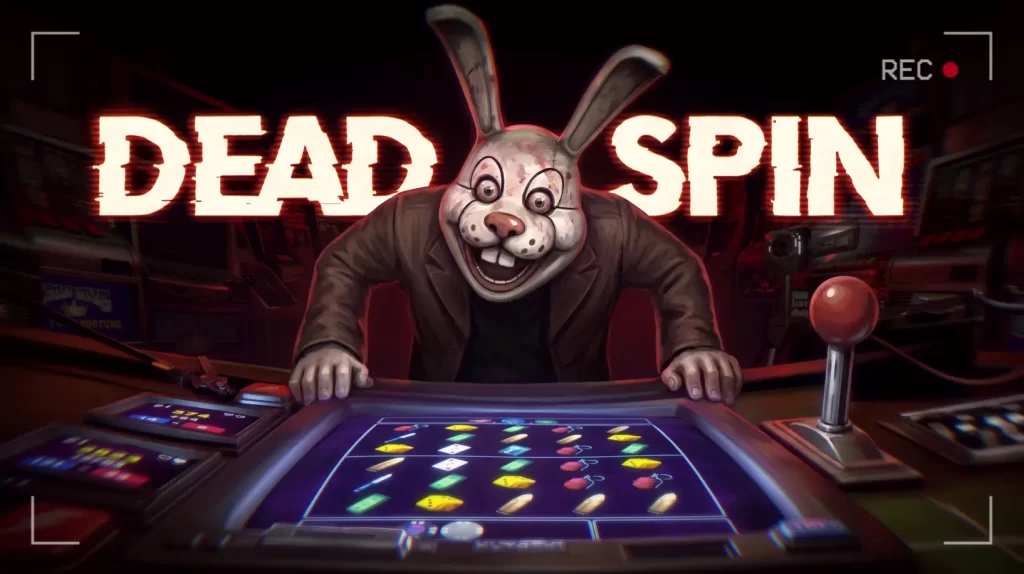
Sometimes a game sells itself on the vibe before anything else. Dead Spin is one of those games.
Before you even get into the actual mechanics, it already has a grip on you just through the atmosphere. The whole thing has that grimy late-90s, early-2000s horror game feel to it, like you have somehow stumbled into an abandoned arcade where somebody definitely wants you dead. The screens flicker, the creatures opposite you look all kinds of wrong, and the whole setup feels like you have been kidnapped and strapped in for a very bad evening.
It is not subtle, but that works in its favour.
And once the actual game starts, it turns out the vibe is not the only thing doing the heavy lifting.
It is not just Balatro with a creepy face taped on
The easiest comparison is obviously Balatro, because the game is built around score-chasing, synergy, and trying to break things in your favour through clever combinations. But Dead Spin is not just copying that formula and dressing it up in horror wallpaper like Balatro had a baby with Five Nights at Freddy’s.
It is doing something a bit stranger than that.
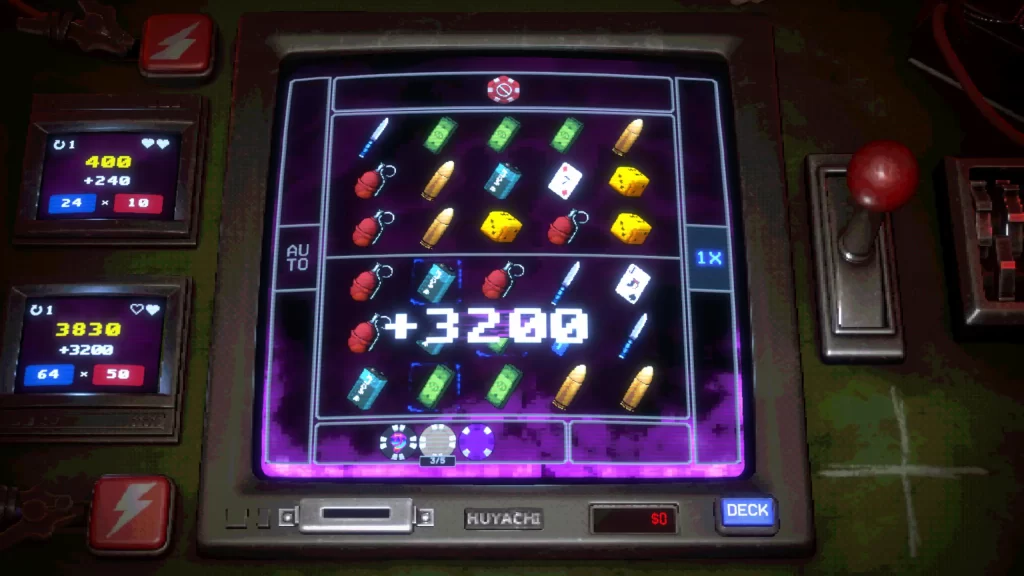
Instead of building poker hands out of whatever cards land in front of you, here you are working with symbols that land across reels, and those symbols need to actually connect in meaningful ways to pay out. That means horizontally, vertically, or in combinations that let different parts of the board talk to each other. Straight away, that makes it feel a little harsher and a little less forgiving, because you are not simply choosing the best hand from what appears. You are relying on a more chaotic layout and trying to bend that chaos in your favour.
That gives the whole thing its own identity.
Building your run feels properly satisfying
The Dead Spin playtest only offered four bosses, but it was enough to get a good feel for how the loop works.
You start with a basic spread of symbols, more low-value rubbish than the exciting stuff, then slowly build something stronger through the money you earn. That cash lets you buy better symbols, cut out symbols you do not want cluttering things up, and start steering the run towards whatever strategy seems to be taking shape.
That is where the chips really come in.
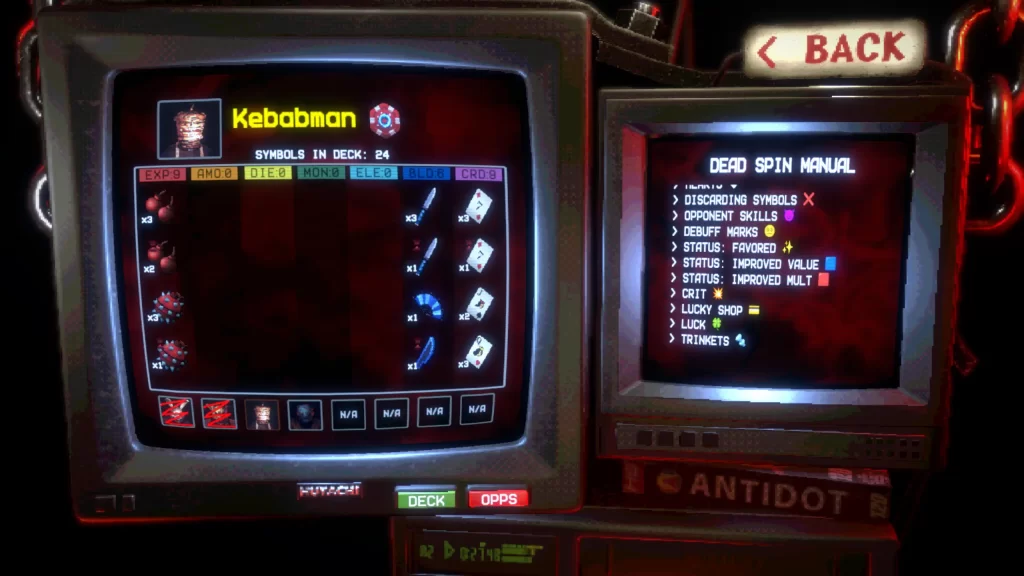
They feel a bit like the joker-style modifiers people will instantly compare them to, but Dead Spin handles them in a way I actually found quite satisfying. It is not just about replacing weaker chips with shinier ones. You can stack chips of the same type to strengthen what they do, which makes your build feel a little more deliberate and a little less like you are simply swapping old toys for new ones.
Some chips reward specific symbol types. Some lean into retriggers. Some boost combinations. Some just help your whole build get more ridiculous. That part is where the game starts getting properly interesting, because you can feel yourself nudging a run from “random nonsense” into “alright, I think I see what I am doing now”.

The trinkets and lives help stop it feeling too punishing
Another thing I liked about Dead Spin was the way trinkets fit in between bosses.
After wins, you get a choice to pick two of them from a choice of four, and they offer benefits like extra spins, removing debuffs, protecting spaces on the reels, or giving you more hearts. That last part matters, because you are not instantly dead the second things go badly. Each boss is effectively a best-of-three situation, which gives you a bit of breathing room. If you have a rough round, you can take the hit, rethink things slightly, and try to come back stronger.
That helps Dead Spin feel tense without feeling miserable.
There is still plenty of pressure, mind. Every match ends with that lovely little flourish where a button gets pressed and the loser is electrocuted, and a second shock means you are done for good. It is nasty, theatrical, and exactly the sort of flourish this game should have.
The bosses are doing the right kind of weird
The actual opponents help a lot too.
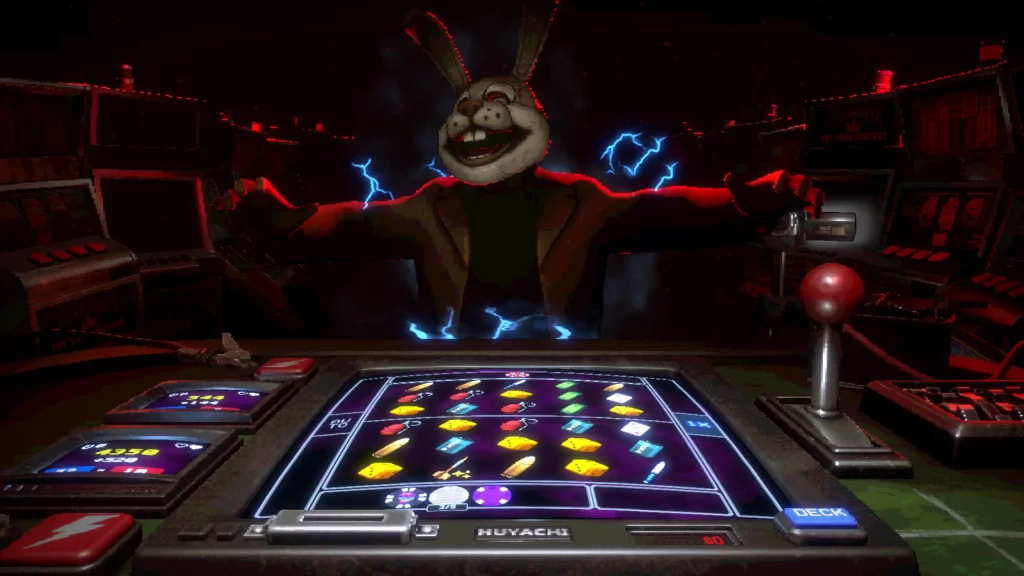
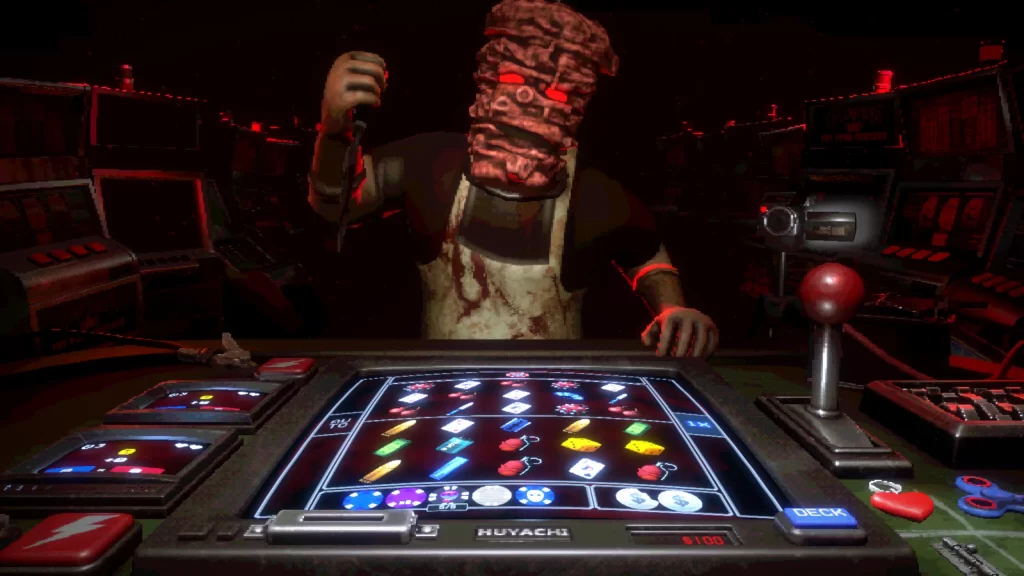
The first few bosses in the playtest felt strong enough to be memorable without completely flattening me. A rabbit, a pig, and then Kebabman, because clearly somebody at Strong Monkey Games is having a nice time. Each one had enough personality to make the runs feel like more than just abstract score duels against a number.
That matters in a game like this.
Even without a big narrative push, Dead Spin still manages to feel like a proper confrontation every time you sit down opposite one of these weird little freaks. It gives the whole thing a bit more life than if it had just been symbols, scores, and a blank face staring at you from across the room.
The balancing wobbles a bit at the top end
The one big issue I had with Dead Spin was the final boss available in the playtest.
Bagman felt absurdly overpowered.
His own symbol deck was already strong enough to be a problem, but his ability to bag your symbols and stop combinations from paying out just made it feel like the deck was stacked too far in his favour. I had what I thought was a pretty decent build going and, on a good round, I could maybe scrape together around 15,000 points. He was smashing out well over 100,000.
That is not a close fight. That is not even me being a bit unlucky. That is me being sat opposite someone who has turned up with a gun to a slot machine duel.
Now, because this is a playtest, I am not going to get too dramatic about it. This is exactly the sort of thing playtesting is for. But it definitely stood out, and if the later bosses in the full release of Dead Spin are all tuned around that kind of leap, the game is going to need to be very careful it does not tip from challenging into daft.
It wears its inspirations openly, but still feels like its own thing
Dead Spin will absolutely get compared to Balatro, and that is unavoidable.
But honestly, I do not think that is a bad thing so long as it keeps doing what it is doing here, which is twisting the idea into something nastier, more claustrophobic, and a bit more random in a way that suits the horror angle. It feels less like a rip-off and more like a game asking what happens if you take score-chasing deckbuilder logic and force it through a cursed casino machine while some horrible arcade goblin watches you sweat.
That is different enough for me.
And the Five Nights at Freddy’s comparison is not miles off either, not because it plays like that, but because it has that same grubby, trapped-in-a-room-with-weird-things energy. You are not just trying to play well. You are trying to survive being in this place at all.
First thoughts on Dead Spin
Dead Spin is still early, and this playtest was only a taste.
There is not much of a story yet, at least not in a way that really takes centre stage, and the boss balancing clearly still needs work. But as a first proper look at the game, it already has enough going for it to make me want to see more.
The atmosphere is strong. The reel-based scoring gives it its own twist on the deckbuilder formula. The chips and trinkets are fun to build around. The bosses are memorable. And even where it feels rough, it feels rough in the sort of way that seems fixable rather than fundamentally broken.
Most importantly, it has a hook.
It is weird in a good way. Grimy in a good way. A little unfair at times, sure, but interesting enough that I want to see what Strong Monkey Games does with the full thing.
That is a pretty good place for a playtest to leave you.
Dead Spin is developed and published by Strong Monkey Games, and you can download the Dead Spin public playtest now on Steam. For more first looks at unreleased games, check out our previews section.