Getting an indie game onto Steam has never been easier.
Getting anyone to notice it once it is there is an entirely different matter.
Steam remains the obvious destination for most independent PC developers. It offers access to an enormous audience, established purchasing habits and a storefront players already trust enough to hand over their money every time a seasonal sale rolls around.
But it is also staggeringly crowded.
More than 21,000 games were released on Steam during 2025. By late July 2026, another 13,700-plus had already joined them. That is not so much a shop as a tidal wave with a search bar attached.
For smaller studios, simply releasing a good game is nowhere near enough. It needs wishlists, a recognisable identity, appealing store artwork, a decent trailer, press coverage, creators, festival appearances, a community and probably a generous helping of luck.
Recent changes to Steam’s homepage have brought that problem back into focus. Some developers fear Valve has made it even harder for smaller games to earn meaningful visibility. Others believe Steam’s more personalised approach could be better at connecting niche games with the players most likely to care about them.
So, is Steam really making indie discoverability worse?
The answer is an irritating but important one: yes and no.
Popular Upcoming is not quite as welcoming anymore
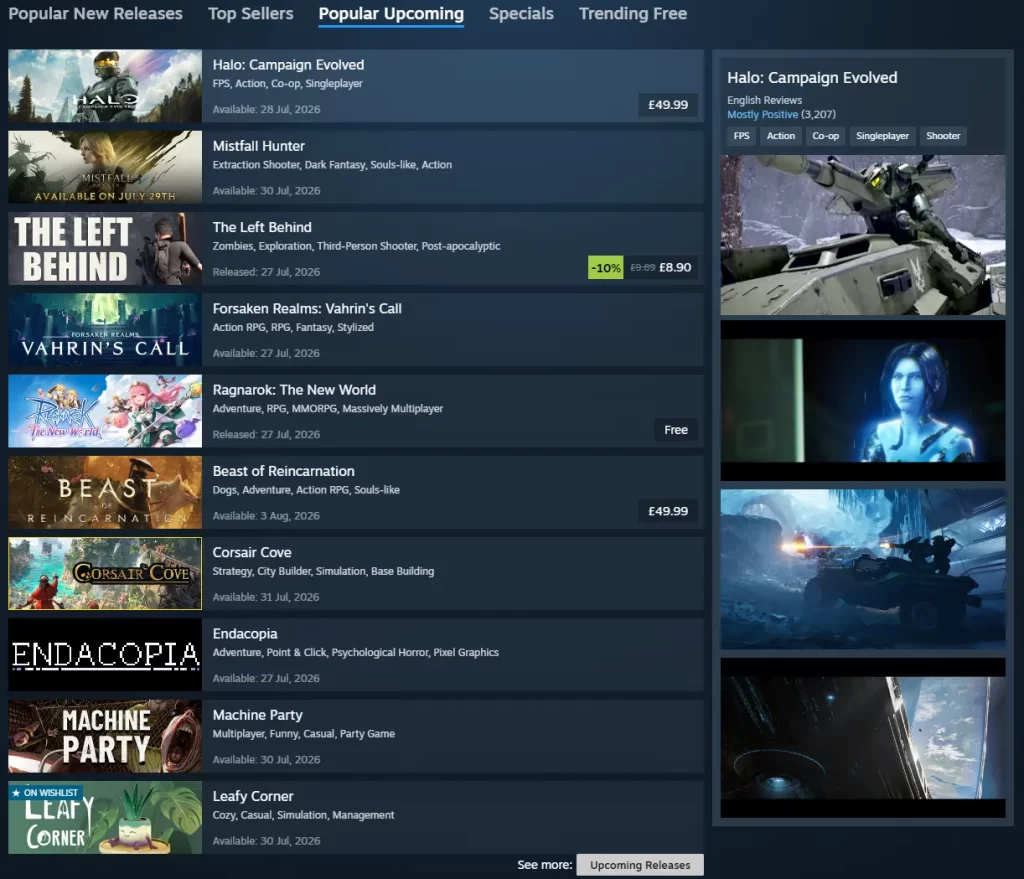
For years, one of the biggest targets in an indie game’s pre-release marketing campaign was Steam’s Popular Upcoming section.
Getting onto that list could place a smaller game in front of a large audience during the final days before launch. It was never a guarantee of success, but it provided a visible rung on Steam’s discovery ladder.
That encouraged developers to focus heavily on wishlists.
The exact number needed was never officially confirmed by Valve, but developers and marketing analysts commonly treated around 7,000 wishlists as a rough target. Reach that level and a game had a realistic chance of appearing in Popular Upcoming. Miss it, and the climb towards areas such as New and Trending became considerably harder.
Steam’s recent homepage changes shifted that balance.
Popular Upcoming now places greater emphasis on games with substantial existing attention, aiming to better represent the biggest releases arriving over a longer period.
From a player’s perspective, that sounds reasonable. Someone opening a section called Popular Upcoming probably expects to find games that are both popular and upcoming.
The problem is that popularity has a habit of feeding itself.
Games backed by major publishers, established franchises or sizeable marketing campaigns already have plenty of ways to reach players. Giving them more of Steam’s most valuable space risks handing another advantage to the games that need it least.
For a tiny studio, Popular Upcoming increasingly looks less like an opportunity and more like a VIP area they can see through the window.
Wishlists were never a magical golden ticket
It is worth clearing up one of the biggest misunderstandings surrounding Steam.
Wishlists matter, but they are not magical algorithm dust.
Valve’s own documentation says wishlists are generally not used to determine a game’s algorithmic visibility, with sections such as Popular Upcoming being notable exceptions. Their most reliable function is much simpler: players who wishlist a game can receive notifications when it launches, leaves Early Access or receives a qualifying discount.
A wishlist represents interest.
It does not guarantee a purchase, front-page placement or successful launch.
That distinction matters because conversations around indie development have become obsessed with hitting particular figures. Developers are repeatedly told to get a Steam page online early, gather thousands of wishlists, enter Next Fest and somehow turn all that momentum into sales.
None of that advice is necessarily wrong.
But it can turn game development into an exhausting exercise in feeding a storefront long before the game is ready.
Every trailer, demo, social post, festival application and creator email becomes another attempt to move a number that may or may not translate into someone buying the finished game.
The danger is not only that developers fail to reach the target.
It is that reaching the target starts feeling more important than making the game distinctive enough to deserve attention in the first place.
Steam’s Personal Calendar could be better for niche games
The Popular Upcoming changes are only one side of the story.
Steam has also introduced a Personal Calendar designed to recommend recent and upcoming games based on each player’s interests. It looks across an eight-week window, refreshes its recommendations regularly and continues showing relevant titles shortly after release.
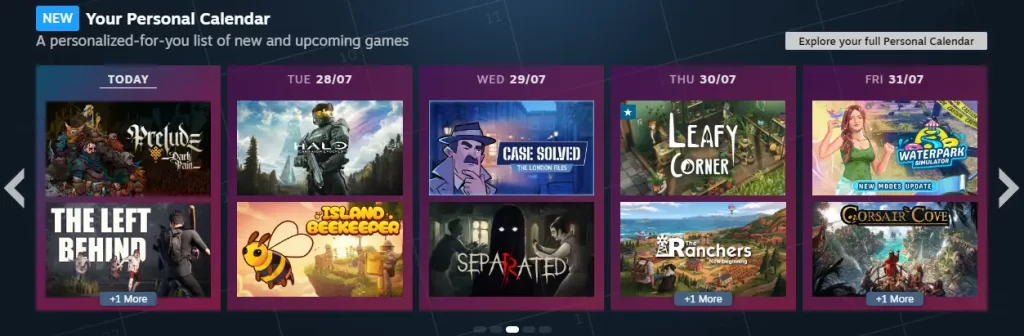
That could be far more useful for genuinely niche indie games than briefly appearing on one universal list.
A strange turn-based dungeon crawler does not need to be shown to every person who opens Steam.
It needs to reach people who already play strange turn-based dungeon crawlers.
Early analysis of the Personal Calendar has produced some encouraging examples. How To Market A Game reported developers receiving hundreds or even thousands of wishlists per day after appearing in personalised calendars, with visibility potentially beginning two months before release and continuing for around a month afterwards.
Those examples should not be treated as a universal promise. The system is still relatively new, and successful case studies tend to travel much further than stories from games that saw little change.
Still, the principle is promising.
Raw visibility looks impressive on a graph.
Relevant visibility is what sells games.
A smaller number of interested players is worth far more than thousands of impressions from people who were never going to click in the first place.
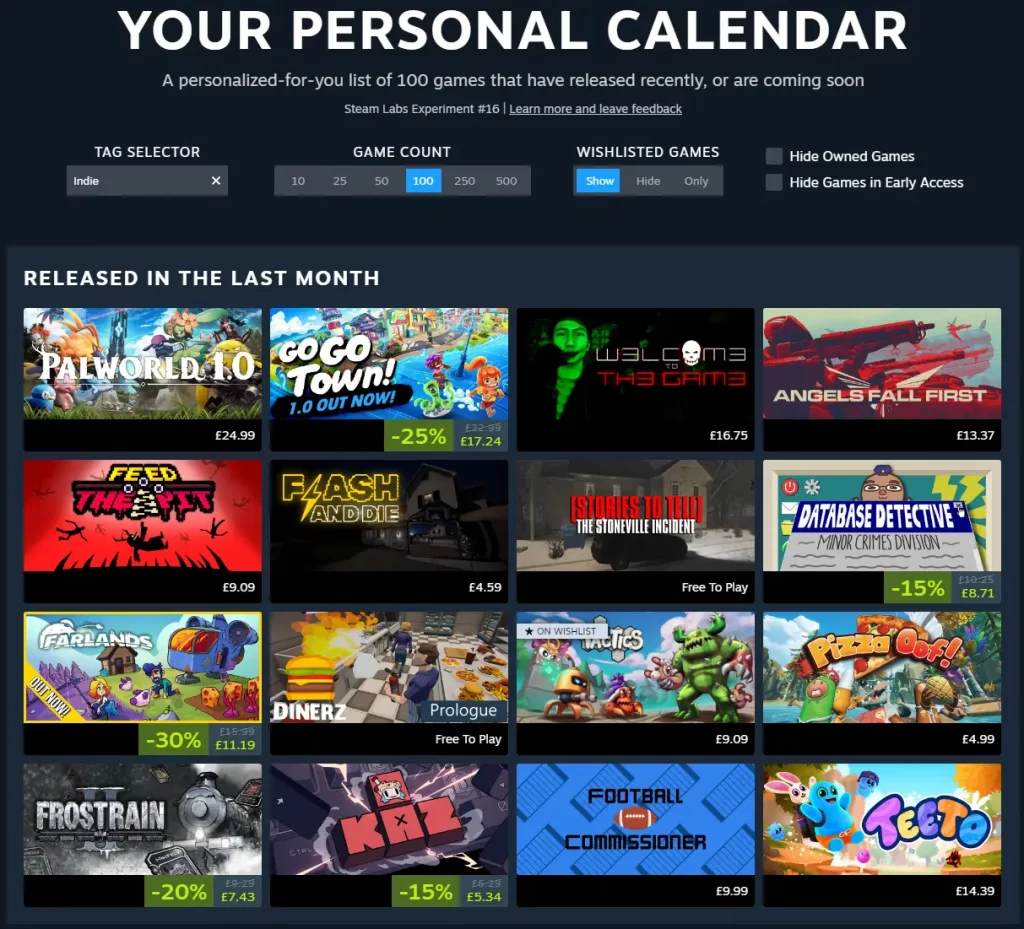
One thing we like about it specifically, though, is when opening the full calendar, you can actually tailor it using tags from games. So you can use it to help locate the latest released indie titles, as well as upcoming ones, as in the image below.
The attention still has to come from somewhere
Personalisation does not completely solve the problem.
Steam still needs signals to decide which games should be shown to which players. Valve says purchases, active players, supported languages and accurate tags all influence how games are surfaced around the store.
That creates a familiar problem.
How does a game generate meaningful signals before Steam has shown it to anyone?
The uncomfortable reality is that Steam often works best as an amplifier.
A developer brings the initial audience through social media, mailing lists, conventions, demos, press coverage, Discord communities, streamers or an existing following. Steam notices that people are interested and begins showing the game more widely.
For studios that already have an audience, that can work brilliantly.
For a first-time developer with no marketing budget, no industry contacts and no idea how to convince a content creator to open an email, it can feel like being told they need experience before applying for an entry-level job.
Valve itself encourages developers to build awareness before release. Its guidance tells studios to create a Coming Soon page, post announcements and get potential players excited, acknowledging that some customers may need to encounter a game dozens of times before paying attention.
Steam provides the shop.
Increasingly, developers are expected to provide the crowd.
Being good is no longer enough
This is probably the hardest truth for independent developers to accept.
A genuinely good game can fail.
Not because it was broken. Not because players hated it. Not because the developer did something obviously wrong.
It can fail because too few people ever knew it existed.
With thousands of games launching every month, even a fair discovery system would leave plenty of worthwhile releases unseen. Steam can give new titles some baseline exposure, but there is only so much room on a homepage, and only so much attention players have to spare.
Not every game released on Steam deserves equal promotion either.
The platform contains asset flips, unfinished experiments, cynical trend-chasers, joke releases and projects seemingly pushed onto the store with less care than most people put into naming a folder.
The problem is that interesting small games are buried in the same pile.
A personal RPG made by one developer may look less commercially polished than a generic project with expensive capsule artwork. A rough demo with a brilliant central idea can struggle beside games backed by specialist marketing agencies.
Steam cannot reliably judge creative value.
It can only follow data.
And data tends to favour games already generating sales, activity and attention.

Everyone is following the same advice
Another issue is that indie marketing has become increasingly formulaic.
Developers are told to:
- Launch their Steam page as early as possible
- Create a demo
- Enter Steam Next Fest
- Post regular short-form videos
- Contact streamers
- Build a Discord server
- Collect wishlists
- Avoid launching near major releases
- Continue updating after launch
Again, none of that is inherently bad advice.
The problem is that everyone is doing it.
Steam festivals become harder to navigate because thousands of demos arrive together. Creator inboxes fill with near-identical pitches. Social media algorithms decide that only a tiny percentage of followers should see a studio’s posts.
A strategy stops being an advantage once it becomes the minimum expected behaviour.
That leaves developers trying to run a full marketing campaign while also making the game, fixing bugs, managing contractors, answering community questions and worrying about whether there will be enough money left to survive after launch.
For a solo developer or tiny team, the workload can become completely unreasonable.
The industry talks constantly about developers needing to market better.
It talks much less about how much unpaid labour that increasingly involves.
More personalisation could reward clearer identities
There may be one positive consequence of Steam’s increased personalisation.
For years, developers have been encouraged to build games around proven, marketable genres. That is partly why successful ideas arrive in waves.
One deckbuilder takes off, and dozens more follow.
One cosy farming game becomes huge, and suddenly everyone is planting turnips.
One co-op horror title produces viral clips, and Steam fills with games about four people screaming into proximity chat.
Making something recognisable is commercially sensible. Players need to understand what they are looking at.
But constantly chasing the same proven categories can flatten creativity.
A personalised storefront could reward games with more specific identities. A project does not have to appeal vaguely to everyone if Steam can identify the smaller audience most likely to love it.
That places even more importance on accurate tags, artwork and store descriptions.
A player should be able to glance at a Steam page and quickly understand:
- What the game is
- What they will actually do
- How it feels
- Who it is for
- Why it differs from everything around it
Being unusual is not necessarily the problem.
Being unclear is.
Developers cannot rely on Steam alone
Steam may be the most important PC storefront, but treating it as the entire marketing plan is increasingly dangerous.
A game needs ways to reach people beyond Valve’s ecosystem.
That might mean:
- Building a mailing list rather than depending entirely on social media
- Joining smaller, genre-specific showcases
- Speaking to specialist press rather than only chasing the largest outlets
- Contacting creators whose audiences genuinely match the game
- Taking part in local events and conventions
- Sharing development honestly rather than manufacturing constant hype
- Working with other developers to cross-promote relevant projects
None of those options is guaranteed either.
But they provide something Steam cannot: a direct relationship.
Algorithms change. Store sections move. Social platforms reduce organic reach. Festivals become overcrowded.
An audience that actively cares about a developer’s work is far more valuable than temporary visibility borrowed from a platform.
That is easier said than done, obviously.
“Build a community” has become one of those pieces of advice that sounds simple until you remember communities are made of actual people who need time, care and reasons to stay involved.
But the developers with the best chance of surviving are often not those who reach the most people once.
They are the ones who give a smaller audience reasons to keep coming back.
Press and players have a role too
Discoverability is not solely a developer problem.
Players constantly say they want original games, but storefront charts remain dominated by familiar franchises, established multiplayer titles and whatever is currently exploding on Twitch.
Gaming media has a role in that too.
It is easier to publish another article about a giant release people are already searching for than to spend time covering a game nobody has heard of. Larger outlets face traffic expectations, search targets and commercial pressures of their own.
But when everyone chases the same obvious stories, smaller games become even harder to find.
That is one of the reasons independent sites (yes, like ours), YouTube channels, curators and creators matter.
They can look beyond whichever game already has the largest marketing budget. They can introduce players to something unfamiliar and give developers coverage that is not dependent on becoming viral first.
Players can help by wishlisting games they genuinely care about, trying demos, sharing recommendations and leaving thoughtful reviews.
None of those actions will single-handedly rescue a game.
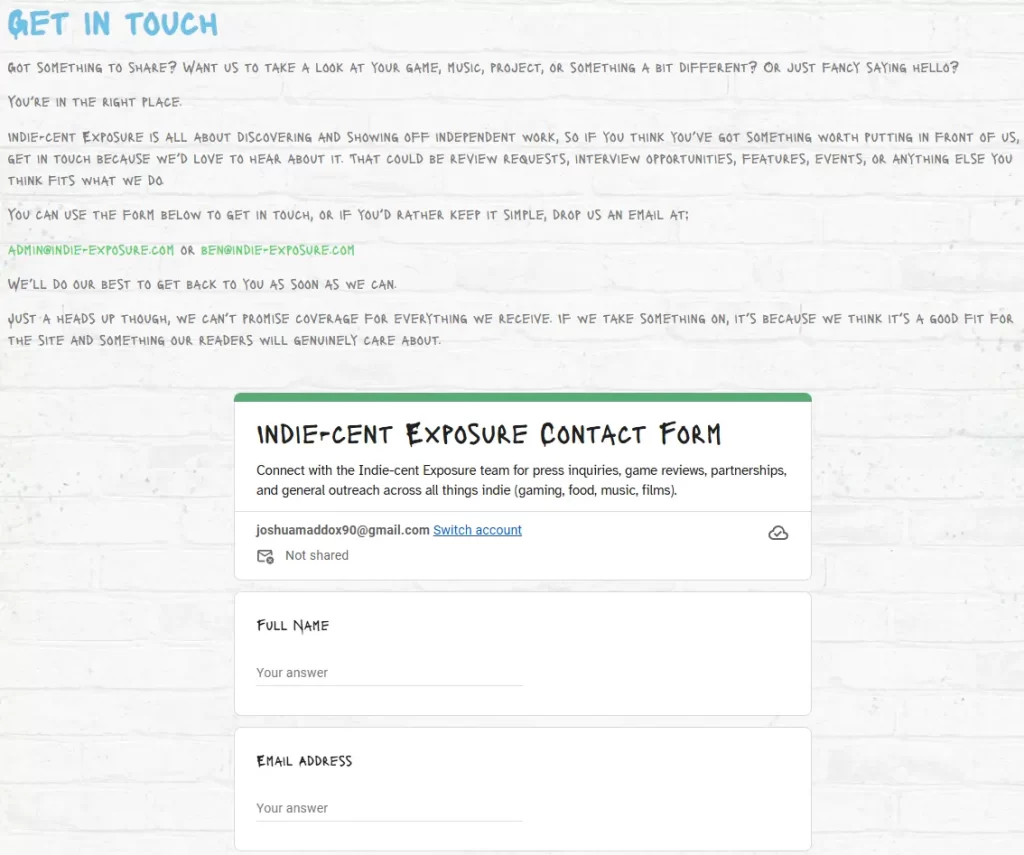
Together, they give Steam more evidence that someone is interested. If you’re an indie dev reading this and want us to cover your game, then head over to our contact page and fill out our form, or just drop us an email.
Valve is not the only villain here
It would be easy to make Valve the villain.
Steam controls the largest PC storefront and has enormous influence over which games find an audience. A change to its homepage can affect years of work and, in some cases, determine whether a studio survives long enough to make another game.
That level of power deserves scrutiny.
But Valve did not create the entire discoverability crisis by moving a few boxes around.
The deeper issue is oversupply.
More games are being released than players could ever realistically see, let alone buy. Marketing knowledge has become almost as important as development ability, while every successful strategy becomes crowded as soon as enough people learn about it.
Popular Upcoming became harder because more developers optimised around reaching it.
Steam Next Fest became overwhelming because thousands of demos began competing during the same week.
Social media became unreliable because algorithms changed while every studio posted into the same endless feed.
There is no button Valve can press that gives every deserving indie game a sustainable audience.
The best it can do is become better at matching games with people.
The Personal Calendar suggests that is what it is trying to do.
Our own personal thoughts
Steam is not making indie games impossible to discover.
But it is becoming increasingly difficult to succeed there without bringing some attention of your own.
The changes to Popular Upcoming understandably worried developers who built their launch plans around reaching that section. Moving the spotlight towards releases that already have huge levels of interest feels like another advantage being handed to those who need it least.
Yet the Personal Calendar could prove more valuable in the long run.
Indie games rarely need everyone.
They need the right people.
A storefront capable of recognising a smaller audience for a strange, specific game may ultimately do more good than one universal list dominated by whichever releases have gathered the most wishlists.
The problem is that smaller developers are still expected to do an extraordinary amount before Steam begins helping them.
They have to make the game, market it, build a community, contact press, chase creators, prepare demos, enter festivals and somehow maintain enough energy to finish development too.
Steam is not necessarily burying indie games on purpose.
There are simply so many of them that being good is no longer enough to guarantee being seen.
That is the real discoverability crisis.
And until the industry finds better ways to connect worthwhile games with curious players, too many brilliant projects will continue launching quietly into one of the busiest shops on the planet.
On the lookout for more deep dives like this one? Then click right here.