There is something inherently unsettling about being lost in the woods after dark. Every path starts looking suspiciously familiar, noises become considerably more interesting than they were during daylight, and that perfectly innocent shape between the trees definitely moved when you were not looking.
Night Hike takes that feeling and builds an entire roguelike around it.
Created by solo indie developer Michael Neumann, Night Hike drops players into a seemingly endless wilderness loop where getting out means quite literally assembling your own escape route. Trails branch, actions are limited, strange residents emerge after nightfall, and even your trusty compass is not above leaving certain decisions to fate.
Rather than filling the forest with things to shoot, Night Hike seems more interested in curiosity, navigation, uncertainty and the uncomfortable question of whether the strange figure you have just encountered is actually something you should be running away from.
With a playable demo having arrived on August 18th, we caught up with Michael to find out where this unusual night time adventure came from, how you design a roguelike around getting lost, and just how much players should trust that compass.
Night Hike demo date reveal trailer
Before we wander too far into the woods, could you introduce yourself, tell us a little about your background, and explain how you ended up developing Night Hike?
I’m Michael Neumann, and I’ve been in the games industry for the last 14 years, the majority of which have been at Minecraft, where I work as a UI Art Lead. I originally started making games all the way back to the early 2000’s when I’d make minigames for Flash portals like Newgrounds, ArmorGames and Kongregate. Night Hike development started in part with the rise of the Godot engine, which I have found to be really easy to learn and simple to use, which inspired me to get back into solo projects.
There is such a simple but effective horror idea at the heart of Night Hike: you are out hiking at night, the wilderness keeps looping, and you cannot seem to find your way home. Where did that original concept come from, and was it inspired by any real experiences of being out in the wilderness after dark?
Haha, my wife and I love hiking, but we typically go in the morning when it’s light outside, and there is no risk of getting trapped in a supernatural wilderness loop. The concept for Night Hike was inspired primarily as an infusion of two of my favourite indie games in recent memory: Blue Prince for the map-drafting mechanic and Inscryption for the creepy escape-the-room atmosphere of Act 1. Both of those experiences have really stuck with me, and when I started dreaming up this project, it just seemed like a fantastic combination.
Night Hike describes itself as a map-drafting roguelike, which is not a combination we come across particularly often. Why did assembling the route itself become the central mechanic rather than giving players a conventional generated map to explore?
Blue Prince really opened my mind to the possibility that maps could be generated in much more interesting, nonlinear methods where the focus is on player agency. I believe there was a lot of inspiration for this mechanic born from traditional board game design rather than previous video games, and I find it to be a really fresh way to approach exploration.
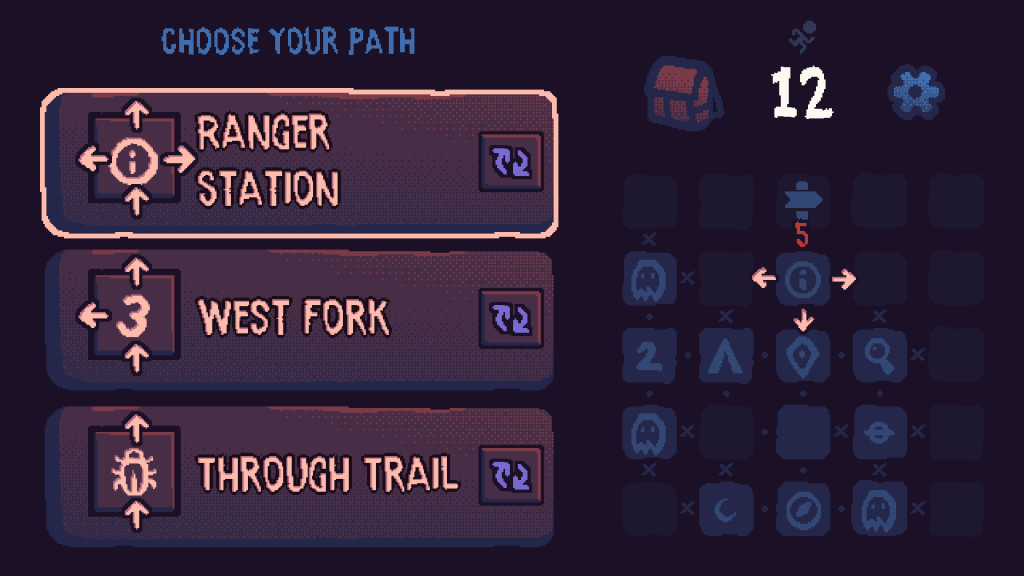
That creates an interesting relationship with getting lost, because players are partly responsible for constructing the very wilderness they are trying to escape. How much did you want people to feel like they are both solving the maze and accidentally making their own problems?
With any roguelike (or rougelite in my case), I think the designer wants the player to explore a lot of different runs, but when a run inevitably ends, you don’t want the player to feel as though that conclusion was unfair or somehow undeserved. Allowing the player to construct the trail helps mitigate this feeling because the choice to go this way or that is entirely theirs. So a run hopefully ends with some ideas of what they could try doing each time differently, to optimise their progress or explore something new.
Every trail presents branching choices, including whether to push onwards or turn back, while running out of actions resets the hike. How do you make those decisions feel genuinely difficult in Night Hike rather than there always being an obviously optimal route?
I’m currently in the phase of development where this is the tricky balance I’m probably thinking about the most. In order to finish the hike, the player will have to balance multiple resources simultaneously (trails that head in the right direction, number of actions, and the power of their compass). When I give branching choices, I try to give only one of those benefits at a time so that decisions are based on the resource that currently is the most at-risk, rather than one resource always being the best choice every time.
Then there is the compass, where spinning the needle can determine whether you succeed or fail at obstacles, but players can also power it up to improve their chances. How did you find the right balance between randomness and player agency so failure feels tense rather than arbitrary?
It’s back to that tricky balance because you need both randomness and player agency to work simultaneously. The compass in Night Hike was actually designed as a D8 dice roll, but instead of every roll having the same odds, I give players opportunities to modify the values so that they retain some control over what the odds are. You could go tall and have the odds be closer to 1-12 or go wide and have odds be 4-6. I want the results to reflect both randomness and player choice simultaneously.

Is part of the idea for Night Hike that players gradually learn how to manipulate their odds and understand the wilderness better, even when an individual hike gets wiped away?
100%. There will be a variety of ways to progress, and each run is intended to give some form of progression. Sometimes it will be through permanent upgrades or unlocks that you discover through exploration, and other times it will be through understanding the wilderness better, recognising patterns and ways to manipulate the odds in your favour.
The forest is apparently far from empty, with supernatural residents appearing after nightfall whose intentions may not always be clear. How did you approach creating characters who make players curious enough to interact with them while still leaving that little voice saying, “This is probably a terrible idea”?
This has been a really fun part. When a face appears in the dark, it’s a pretty juicy temptation to at least hear what it has to say, right?
How much can those relationships actually change a run? Are these encounters primarily about narrative discovery, or can trusting, helping or upsetting the wrong resident dramatically alter your chances of escaping?
Interacting with residents plays a huge role both in shaping your run as well as narrative discovery. For the sake of the demo, it’s primarily fun, beneficial relationships at the moment, but when the game opens up to the multiple-mile adventure, I’m seeing the opportunity to make relationships and trust more multi-dimensional.

Night Hike sits in an interesting tonal space. It is dark, supernatural and potentially threatening, but there is also something strangely inviting and almost cosy about wandering these trails. Was balancing comfort and unease something you were consciously aiming for?
Definitely, I have seen the market open up to this space recently and want to be a part of it. I don’t think of myself as a horror fan, but I do enjoy dark atmospheres (no to jumpscares, yes to spooky vibes). Playing games like Strange Antiquities, Cult of the Lamb, and Easy Delivery Co. has really allowed me to realise that there can be a fun space between dark and cosy. I want Nike Hike to feel like you’re on a relaxing stroll through a dark, never-ending wilderness.
In a game built around repeating the same impossible night, how do you tell a larger story without repetition starting to work against you? Do failed hikes still move the player closer to understanding what is really happening?
This is why I’d classify Night Hike as a roguelite (with some permanent progression) rather than a traditional roguelike. I want to be able to keep the story moving along, so I designed narrative moments to double as progression stepping stones that help the player get to the next moment and mitigate the amount of time where the experience feels stale.
Night Hike’s Steam description places a lot of emphasis on curiosity, hidden trails and mysteries rather than combat. Was avoiding a conventional combat system an important decision for you, and does that force you to find more interesting ways of creating danger?
For sure, this ties back into the games that inspired Night Hike as well as the expanding audience of gamers who are interested in games that are not combat-focused. I genuinely feel there are so many ideas that have not been explored yet simply because we have a habit of forcing a health bar on the screen.

As a solo developer, Night Hike puts an awful lot of different jobs on one person, from game design and programming through to atmosphere, narrative and everything surrounding the release. Which part of making the game has challenged you most, and which part have you enjoyed disappearing into?
I honestly love solo development and being a multidisciplinary designer/developer. Visual design comes most naturally to me, but I get a lot of energy from learning the disciplines that I have less experience with, like writing code and sound design. It’s a very special and satisfying experience when it all comes together, and you have very intimate knowledge of how every bell and whistle operates.
The background music is the only element that I decided to seek external help with, but I’m really happy with the composer that I found for this. The most challenging role so far would be in my ability to market and articulate why people should be interested in the game, but I’ve also enjoyed learning this part of game development and feel that I’m slowly getting better at it.
The demo launched on 18 August, so you are about to have considerably more people wandering around your woods. What have you chosen to include in that first public taste of Night Hike, and what do you most want to learn from players once it is in their hands?
Night Hike is a 5-mile adventure (with the first mile being an onboarding tutorial), so I’ve opted to have the demo focus on mile 2 and getting the core mechanics to really click with players before I open up the later miles and attempt some of my more ambitious ideas. I want to make sure I get that right before expanding on it, because if the majority of players don’t understand how to use the compass, for example, then I really should focus on fixing that before going deeper.
Finally, imagine somebody reaches the end of their first evening with the Night Hike demo. What do you hope they are thinking as they close the game: “I need to work out how to escape”, “I need to know what the hell is happening in those woods”, or simply “one more hike”?
Genuine intrigue for the path ahead and a hunger to unravel the underlying system. I want the demo to ignite enough curiosity to bring my fellow hikers back to the trails so they can discover the experiences that are hidden even deeper in the woods. Not because they want to escape, but perhaps there is something oddly satisfying about being lost.

A big thank you to Michael Neumann for taking the time to wander into the darkness with us and shed a little more light on Night Hike.
There is an appealing simplicity to the setup: you are lost, night is refusing to end, and somehow you need to construct a route out. But everything Michael is building around that idea, from the compass and limited actions to mysterious residents and trails that may be better left undiscovered, suggests there is considerably more hiding between those trees.
Night Hike’s demo arrived on 18 August, giving players their first proper opportunity to see whether they can find a way out for themselves.
Just remember: if you have been walking for ages and that tree looks suspiciously familiar, you may have a problem.
Want to check out more of our chats with game developers and other people in the gaming industry? Head over to our interviews section.