
Mobile gaming has given us some brilliant ways to kill five minutes, but it has also taught us to expect something else: interruptions.
Finish a level? Watch an advert. Want another life? Watch an advert. Accidentally press the wrong part of the screen? Congratulations, you may now know considerably more about an unrelated mobile game than you ever wanted to.
Aevryn Candy wants no part of that.
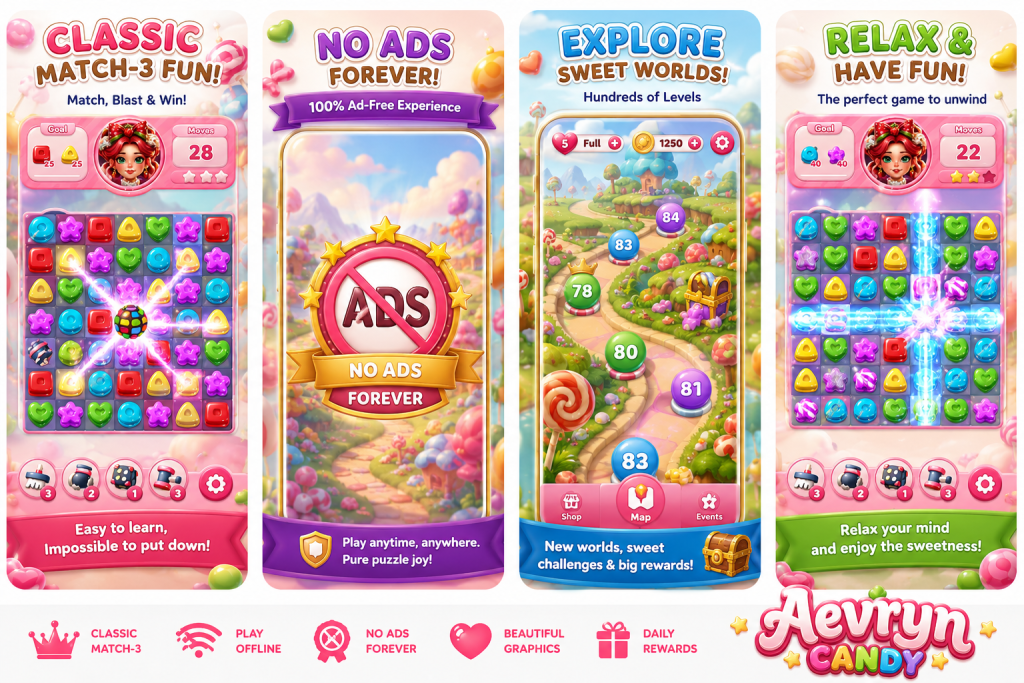
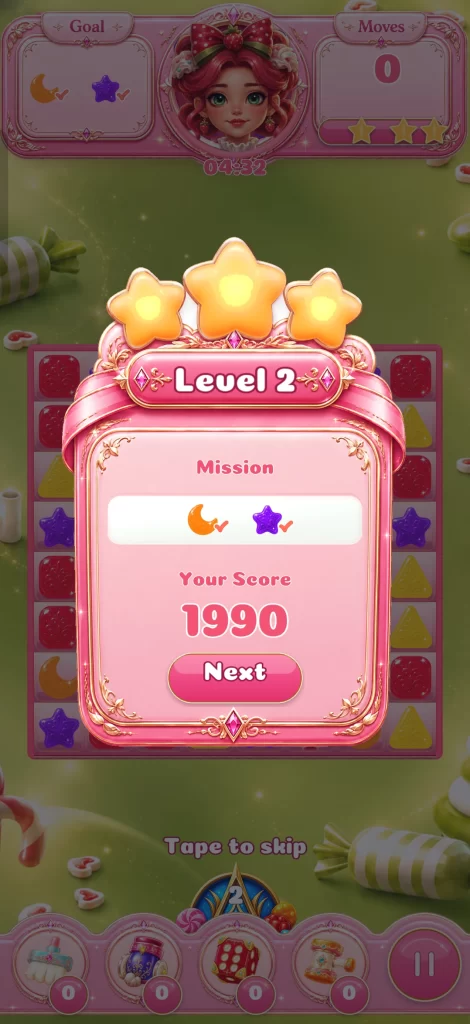
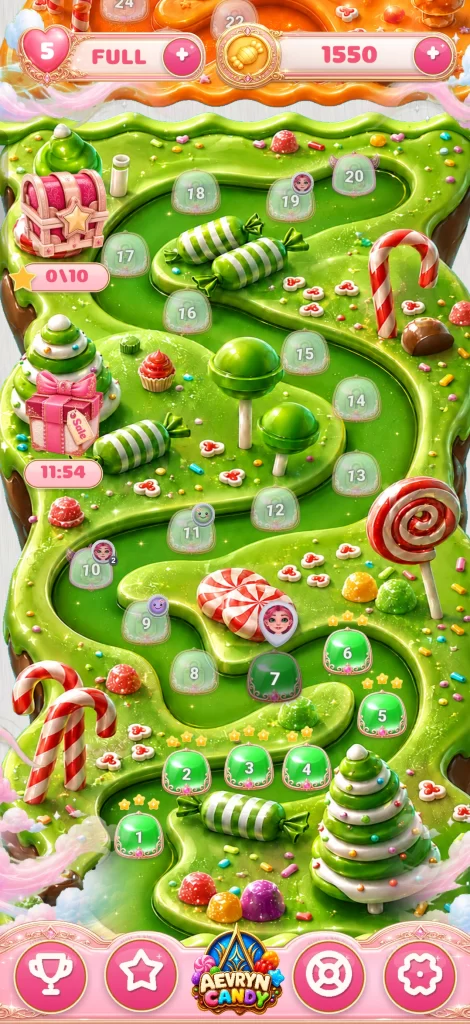
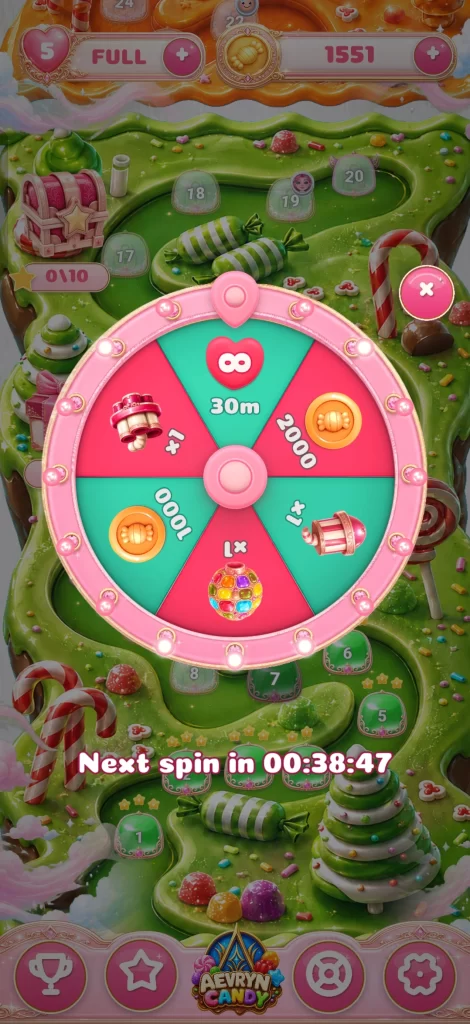
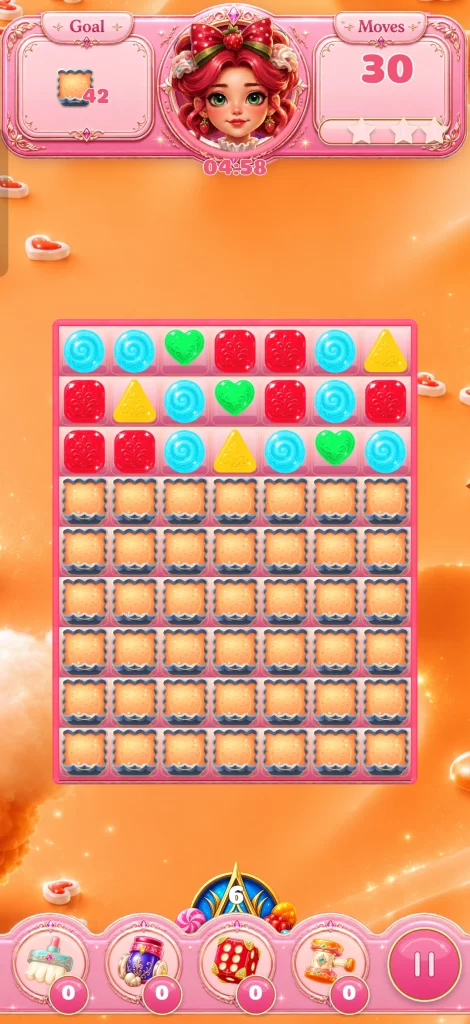
Created by solo developer Ricardo under Aevryn Studios, the recently released Android game takes the familiar match-3 formula and builds around a simple promise: no ads, ever. Players can work through colourful candy-themed worlds, create combinations, use boosters and progress at their own pace without the usual procession of videos breaking things up.
Of course, entering one of mobile gaming’s most established genres as an independent developer brings its own challenges. Aevryn Candy still needs to stand out among thousands of alternatives, support itself financially, and find a balance where optional purchases remain genuinely optional rather than becoming the reason levels suddenly start fighting dirty.
We caught up with Ricardo to talk about why he chose match-3, what pushed him towards an ad-free model, the realities of solo mobile development, and whether a free-to-play game can make money without constantly trying to annoy players into spending it.
Before we get into Aevryn Candy, could you introduce yourself and tell us a little about your background? What brought you into game development, and how did Aevryn Studios come about?
I’m Ricardo Tavares Santos, the solo developer behind Aevryn Studios and Aevryn Candy. With Aevryn Studios, I wanted a place where I could build and improve games around clear design choices rather than trying to imitate the scale of large mobile publishers. Aevryn Candy is the project where that became concrete: a small Android match-3 focused on colourful puzzles, short sessions and an interruption-free experience.
Match-3 is one of the most established and competitive genres on mobile, with some absolutely enormous games already dominating that space. What made you look at that market and decide there was still room for Aevryn Candy?
I wasn’t trying to reinvent match-3. The rules are familiar, which actually makes it easier to focus on the experience around them. What I wanted to change was one very visible part of mobile gaming: the interruptions. Aevryn Candy is built around a simple promise — “No Ads. Ever.” — and around making the familiar puzzle loop feel pleasant rather than constantly interrupted.
Was the relaxing experience always the starting point? Did you begin with the idea of making a calm, colourful puzzle game, or did that identity develop as you worked on the mechanics?
The relaxed identity became clearer as the game developed. Once advertising was removed from the design, the game itself had to create the rhythm. That pushed me to think more deliberately about pacing, difficulty and giving players breathing room instead of treating every new level as another step up in frustration.
The phrase you keep coming back to is “No Ads. Ever.” That is a pretty definitive promise in a market where advertising is everywhere. What made avoiding ads so important to you personally?
I wanted the player to decide when a play session pauses or ends. In many free mobile games, advertising becomes part of the rhythm: finish a level, watch something; lose, watch something; want a reward, watch something. Removing that entirely became more than a monetisation choice. It became a design rule that helps define what Aevryn Candy should and should not do.
Do you think mobile games have become too comfortable with interrupting the player? Was there anything you experienced in other games that made you think, “I absolutely do not want Aevryn Candy doing that”?
Advertising interruptions are so common in free mobile games that they can start to feel like part of the genre itself. I wanted to test the opposite approach: let somebody open the game, play a few levels and leave naturally, without a video or interstitial deciding where the break happens.
Removing advertising also removes one of the easiest ways for a free mobile game to generate revenue. Aevryn Candy instead uses optional in-app purchases. How difficult is it to make that financially sustainable without undermining the relaxed experience you are trying to create?
That is one of the real challenges of the model. Optional in-app purchases can exist, but I don’t want monetisation to become the reason the game creates frustration. The design principle comes first: advertising is never required to continue playing, and changes to progression should make the puzzle experience better rather than manufacture pressure.
There is a criticism often aimed at free-to-play puzzle games that difficulty can sometimes feel deliberately engineered to create frustration and encourage players to buy boosters or extra help. How do you make sure your own progression never crosses that line?
I’ve been experimenting with difficulty as a rhythm rather than a straight line. Around level 100, for example, I started reducing the number of candy colours in selected groups of levels, which can make useful matches easier to find. Harder sections can then be followed by breathing room. I prefer thinking “challenge → breathing room → challenge” rather than “hard → harder → harder”.
Boosters themselves can be useful puzzle tools rather than just monetisation hooks. What role do you want them to play in Aevryn Candy, and can somebody reasonably experience everything without ever spending money?
I think boosters should support the puzzle rather than define the business model. One lesson from development has been to try changing existing parameters before inventing another mechanic or system. A small change such as the number of candy colours can significantly affect matches, cascades and available moves without asking the player to learn something new.

Because the basic match-3 rules are already understood by millions of people, differentiation has to come from somewhere else. What do you think gives Aevryn Candy its own personality beyond simply being an ad-free alternative?
The personality comes from the combination of colourful candy-themed presentation, short puzzle sessions, pacing and the constraints I use when deciding what belongs in the game. “No Ads. Ever.” is the clearest one, but the broader rule is that if something damages the relaxed, interruption-free experience, it probably doesn’t belong just because it is common in mobile games.
Designing large numbers of match-3 levels also seems deceptively difficult. How do you create progression that gradually becomes more interesting without simply giving players fewer moves or piling on increasingly frustrating obstacles?
I try not to assume that progression must always mean adding more systems or making every level harder. Sometimes changing one parameter is enough. The candy-colour experiment is a good example: it changes the probability of matches and cascades, so a level can feel noticeably different without adding another rule. That also keeps the project easier to balance and maintain.
You describe the game as something players can enjoy at their own pace. Does that mean you are deliberately avoiding some of the other pressure mechanics common to mobile games, such as aggressive timers, constant limited-time events or systems designed around fear of missing out?
The principle is to avoid features that damage the relaxed, interruption-free experience. I use that as a filter for future decisions. A feature shouldn’t earn a place simply because it is common elsewhere; it should make the puzzle experience better.
You are developing this as a solo creator, so everything from designing levels and balancing boosters to updates, store visibility and player support ultimately comes back to you. What part of releasing a mobile game independently has proved harder than you expected?
Scope is one of the biggest design problems in a small project. Every feature costs more than the initial implementation: it needs presentation, balancing, testing, maintenance and compatibility with everything added later. I’ve learned to ask whether an idea genuinely improves the puzzle or whether I’m adding it simply because I can.
Discoverability on Google Play can be brutal, especially for a new developer competing against publishers with enormous marketing budgets. How are you approaching the problem of getting Aevryn Candy in front of people when simply releasing a good game does not guarantee anyone will ever see it?
I’m trying to build awareness organically and give people a clear reason to remember the game. Independent editorial coverage and developer stories have been useful because they explain the thinking behind the project rather than just repeating a store description. The “No Ads. Ever.” promise also gives the game a simple, understandable position. I know a small indie project can’t outspend the large mobile publishers, so the approach is to keep improving the game while gradually finding players who value the same kind of experience.
Aevryn Candy has launched on Android first. Why was that the right starting platform, and would you eventually like to bring it to iOS, PC or anywhere else if the audience is there?
Android is the platform where Aevryn Candy is available today, through Google Play. My focus is on improving that version and learning from real players rather than promising platforms that haven’t been announced.
Finally, if Aevryn Candy grows exactly as you hope, what would success look like to you? Is it building a large audience, proving an ad-free free-to-play model can work, giving you the freedom to make more games, or simply creating something people genuinely use to unwind?
Success would be finding an audience that appreciates what the game is trying to do: colourful puzzles, short sessions, some challenge, and the ability to play without advertising interruptions. I’d like Aevryn Candy to keep improving and reach more players, while showing that a small mobile game can have a clear identity defined as much by what it refuses to do as by the features it adds.
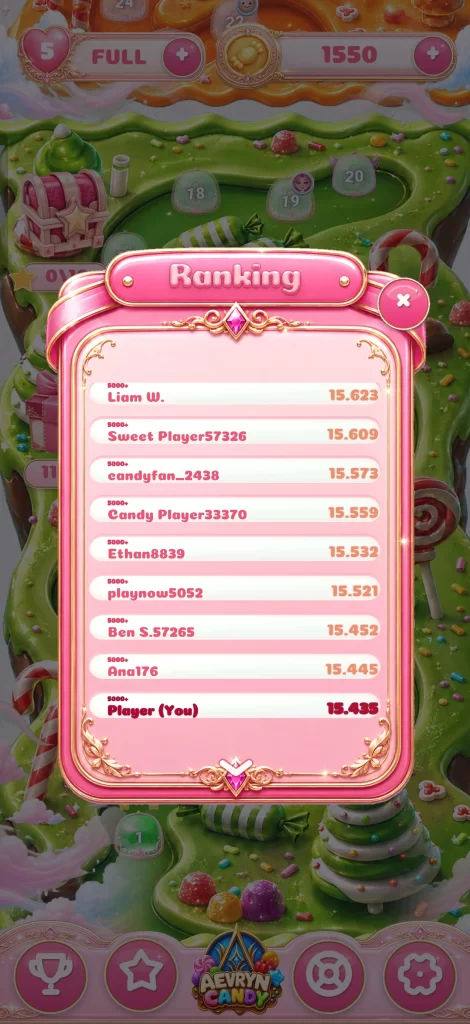
A big thank you to Ricardo for taking the time to speak with us about Aevryn Candy.
There is nothing revolutionary about matching three colourful things together, and Aevryn Candy does not need to pretend otherwise. What makes the project interesting is the decision to take one of mobile gaming’s most familiar formulas and ask whether it can simply be a pleasant game rather than another delivery system for adverts.
That sounds like a remarkably low bar, admittedly, but anyone who has spent much time playing free games on a phone will know it increasingly is not.
The bigger challenge for Ricardo will be proving that respecting the player’s time can coexist with keeping an independent game financially sustainable. Optional purchases still have to fund continued development somehow, and the line between offering convenience and manufacturing frustration can become very thin in this genre.
For now, though, Aevryn Candy has made its promise refreshingly easy to understand.
Match sweets. Solve puzzles. No advert suddenly screaming at you halfway through.
Sometimes simple really does sound quite nice.
Want to check out some of the other indie devs we’ve chatted to and more? Head over to our interviews section.