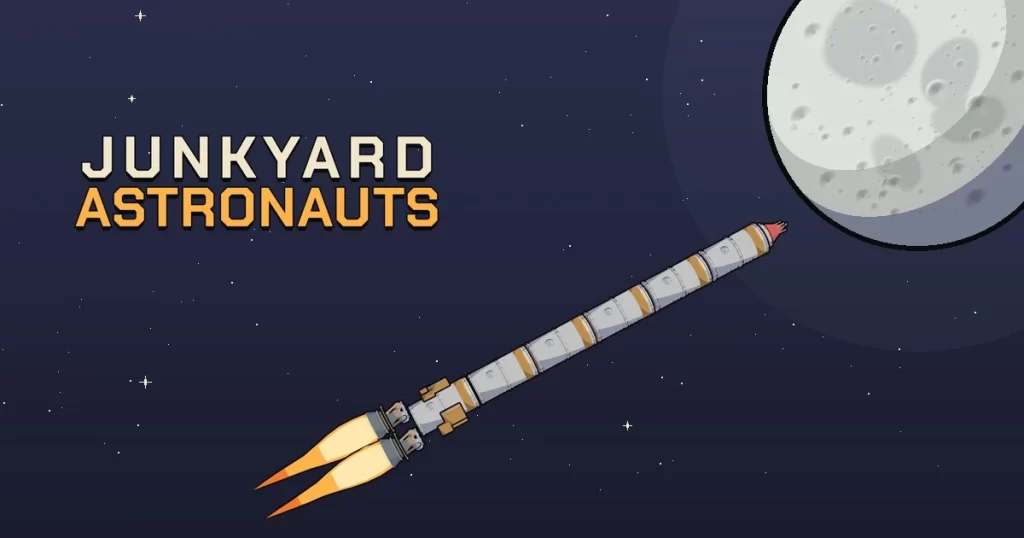
There are probably more sensible ways to reach the Moon than welding a rocket motor to a water heater and hoping physics takes the evening off.
Junkyard Astronauts is not interested in them.
Created by solo developer Halfdan Løvås, better known as muddermis, the upcoming multiplayer game throws up to four robots into a scrapyard with one straightforward objective: build something vaguely rocket-shaped and send it higher than everybody else’s.
What counts as rocket-shaped is apparently negotiable.
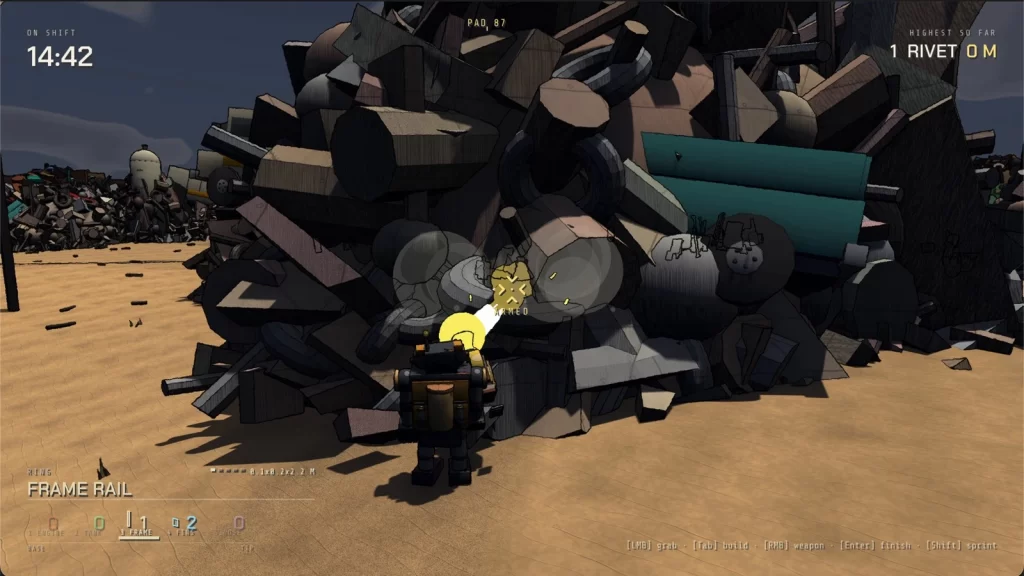
Players scavenge motors, fuel barrels, thrusters, fridges and whatever other questionable engineering materials they can drag back from the junk piles, weld them together, then wheel the resulting monstrosity onto a shared launch pad. Some rockets climb. Others corkscrew into disaster, disintegrate over the yard or return their constituent parts to the ground considerably faster than intended.
Your friends are not necessarily helping either. You can work together on one machine, or simply shoot salvaged parts out of another robot’s pockets and steal them for yourself.
There is also another part of Junkyard Astronauts’ development worth discussing openly. Halfdan has disclosed substantial use of generative AI across the project, including coding, procedural asset generation, sound effects, music, text and localisation. It is one of the broader AI disclosures we have encountered from an indie developer, and one Halfdan deliberately raised himself when approaching us.
With the Junkyard Astronauts demo available now, Steam Next Fest approaching and launch set for 27 October, we caught up with Halfdan to talk questionable rocket science, multiplayer sabotage, developing alone with AI assistance, and where he believes the line sits between using a tool and handing over the creative process.
Junkyard Astronauts gameplay trailer
Before we start welding fridges to rocket motors, could you introduce yourself and tell us a little about your background? How did you get into game development, and where did the idea for Junkyard Astronauts begin?
Hi, I’m Halfdan, 42 years old, and I’ve been messing around with computers since the DOS days, playing Lemmings on our family computer. I’ve always wanted to create something, but coding was never my thing. I’d forget everything after stepping away from the code for a day or two, and that kept me from diving into it. Then came AI, and I could finally start making the stuff floating around in my brain.
I started last year with apps. My first one was a freezer app that I banged my head against for months, but with each new AI model, things got a bit easier, and I finally got it on the App Store. Then it just snowballed. New models made me faster and more efficient, and I set up a whole system to prompt and get the output I wanted.
The next step after apps was games. Honestly, I can’t remember how Junkyard Astronauts came to be, but I got the idea of a robot running around a junkyard, collecting stuff and building a rocket. Started in Godot, then an MCP for Unreal came out, and that got me more excited, and after months of prompting I had the 1-4 player game we’re sitting with now. Honestly, I’m quite happy with it.
The central premise of Junkyard Astronauts is wonderfully easy to understand: grab rubbish, build a rocket and see how high it goes. Was that simplicity there from the beginning, or did you strip away more complicated ideas until you found the version that was immediately fun?
Actually, the other way around. Grab scrap, build a rocket, see how high it goes was the premise from the start. Then I added multiplayer, then the fighting, where the robots can shoot parts off each other, and then teaming up, to make Junkyard Astronauts more chaotic with four friends playing. I think I landed on a nice balance of fun and complexity.
Physics seems to be both the game mechanic and the punchline. A badly built rocket is not just given a lower stat; it can wobble, corkscrew or tear itself apart. How difficult was it to make failure physically believable while still ensuring it is funny rather than simply frustrating?
That took a while. Tuning the building so you could actually get a rocket to fly, and how high. Initially I just wanted busted rockets flying around the yard, but once 1-4 player multiplayer came in to Junkyard Astronauts, there had to be some kind of goal at the end of the round.
That’s where the Moon came in, and with it more fine-tuning: a rocket should be able to fly sideways and tear itself apart, but if you build with some thought behind it, it can actually reach the Moon. It was hard, a lot of trial and error, but like most of the game I tuned it by playing, and when I got the feeling “this is cool”, I left it there.
The build readout judges things like integrity, thrust and efficiency before giving players what sounds like a fairly blunt assessment of their engineering. How much information do you want to give people before launch, and how much should they have to learn by spectacularly getting things wrong?
Initially there was no readout at all. With a 15-minute round, I had to add some kind of check, so people didn’t just run around bolting stuff together and never get a rocket off the ground. The “how good is your rocket” readout is a way for players to gauge the thing before they launch it.
There is a nice loop in failed rockets raining their parts back into the yard as salvage. Was it important that failure itself feeds the next attempt rather than simply resetting everything and sending players back to square one?
It was important that after launching a rocket, players wanted to start building a new one right away. This is supposed to be fast, chaotic and comical. The raining parts were just for fun 🙂
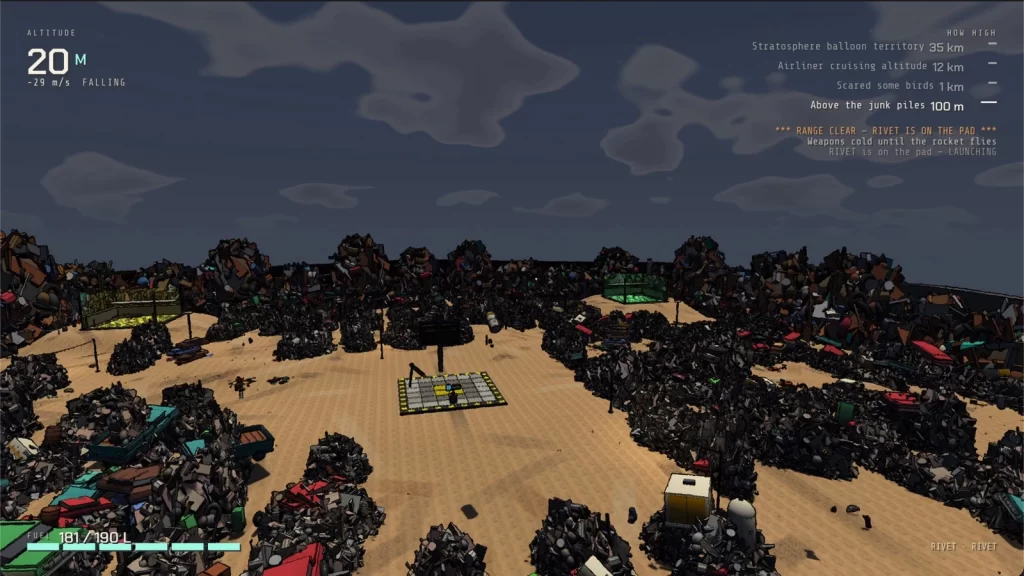
Multiplayer in Junkyard Astronauts seems deliberately balanced between cooperation and being an absolute nuisance. You can crew somebody else’s rocket and share the credit, or shoot components straight out of their inventory. How do you encourage playful sabotage without one determined player being able to ruin everybody else’s night?
You can build rockets together if you team up. The sabotage got reined in from annoying to playful by adding a cooldown on parts lost when you get shot. And if you run around just shooting people, you don’t have time to build a rocket of your own, so you’re really sabotaging yourself. If you do run into someone hell-bent on being annoying, a 15-minute match is short enough that it won’t ruin your whole night (hello, 1.5-hour DOTA 2 match).
The supply crates seem particularly designed to create conflict because everyone sees where they land. Are systems like that deliberately there to manufacture stories between players in Junkyard Astronauts rather than simply hand out useful equipment?
I didn’t want to fill the yard with too much scrap at the start, so players actually have to scavenge a bit. But that left parts scarce, so I had to feed the yard somehow, and supply crates are always a winner. And yes, it makes players gather around points on the map at certain times during the round.
You have four robots with distinct personalities, but mechanically they move and perform the same. Why did you avoid giving them different abilities, and was maintaining a level playing field more important than traditional character classes?
Giving all four robots the same performance was a deliberate choice. I didn’t want to fine-tune four sets of stats, and people will always min-max. Picking a robot should be about looks and fun, not about having the best one.
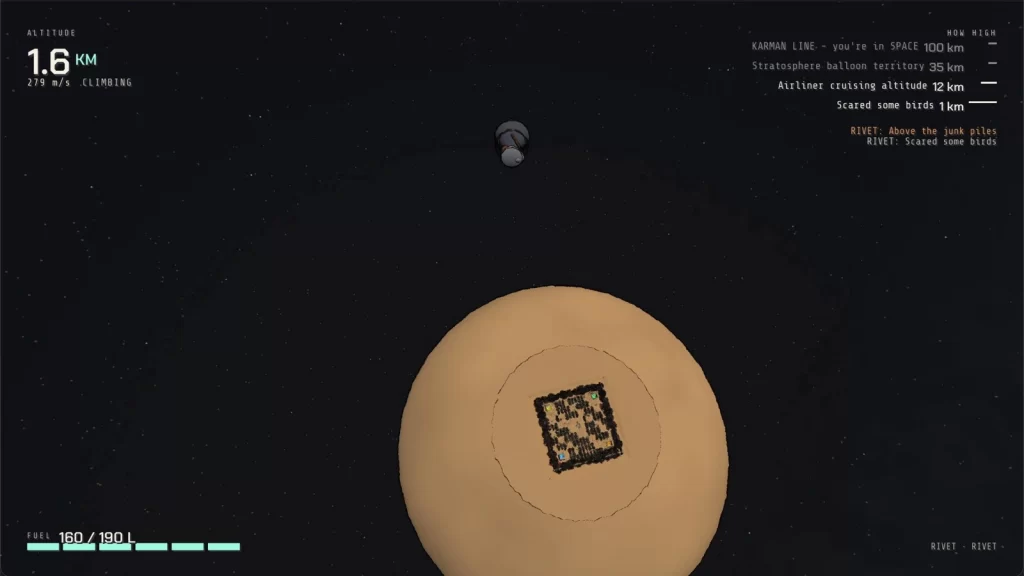
The Junkyard Astronauts demo stops at the Kármán line while the full game lets players chase the Moon, some 384,400 kilometres away. How do you scale progression from “we have technically reached space” to something that absurdly distant without the journey becoming a simple numbers grind?
The Junkyard Astronauts demo stops rockets that would have reached the Moon at 100 km, so that part wasn’t hard. And this is a game about launching your rocket higher than the people you’re playing with in that round. A grind is pretty hard to achieve in 15 minutes.
Your AI disclosure is unusually comprehensive, and you actually raised the subject yourself when approaching us. Why was it important to be this explicit about how Junkyard Astronauts was made rather than simply relying on Steam’s basic disclosure?
People are really vocal about AI in game making, so I put all my cards on the table. I have no coding experience; I can’t make art, I can’t make music. But god damn, I can prompt. So if any AI is a hard no for you, Junkyard Astronauts is not for you.
But I also wanted to show how far you can get with just a basic understanding of how a game should look and feel. The graphics took many, many, many iterations before I was happy with the look, and that was tuned purely by gut feeling.
You say much of Junkyard Astronauts’ code was written with Claude’s assistance. When such a large portion of a codebase comes through an AI assistant, how do you make sure you genuinely understand, maintain and debug what has been produced rather than ending up dependent on the tool to explain its own work?
Honestly, I can’t code, but I can skim it and understand the basic layout. Being around computers, code and games my whole life gives you a certain understanding of how everything is built. So if something doesn’t work or looks off, I can quickly pinpoint what to tell Claude to fix.
The use goes well beyond coding: procedural models and textures come from AI-assisted scripts, most sound effects were generated through ElevenLabs, music uses Eleven Music or an AI-assisted music engine, and even some store text and achievement names involved AI. At that scale, what parts of Junkyard Astronauts do you consider yours distinctly as a creator, and how do you personally define authorship?
Well, AI doesn’t do it by itself (for now), so telling it your exact vision, being able to paint a picture of looks, sounds and gameplay with short prompts, and constantly tweaking it – that is my work. Could I do it without it? Probably. Would it take the rest of my lifetime? Probably.
Again, that’s why I’m so upfront about my AI use; it has been my team. And not to defend it too much, but think of ghostwriters, or bands that use session musicians and producers. I’m upfront about my AI use, but it’s still my vision, my plan, my eyes and ears that have iterated it into a game I’m happy with. So I feel like it’s mine 🙂
One common criticism is that AI does not merely help solo developers achieve more; it can also replace work that might otherwise have gone to programmers, musicians, sound designers, artists or writers. Is the reality here that Junkyard Astronauts simply could not have existed at this scope without AI, or did you consciously choose AI over hiring human collaborators?
Yeah, Junkyard Astronauts would not have existed without AI. Is that a good or a bad thing? Let people play it and decide 🙂 I would never have gotten into game making otherwise. This is a hobby; it’s been my nightly fun. Vibecoding is the new doomscrolling 😛
There are also wider objections around the provenance of training data, consent and creative work being used to build generative systems. Your disclosure says nothing imitates a real person or protected third-party work, but some critics would argue the concern begins much earlier in the training pipeline. How do you respond to that criticism, and have you investigated how the particular AI services you use source their training material?
I’ve been on the internet since the commercial start, and I’ve long since come to terms with the fact that everything I’ve put out there gets used in some way. That doesn’t make the concern invalid; I just don’t lose sleep over it.
On the bigger question: every artist, musician and writer learned from what came before them, consciously or not. Nobody creates in a vacuum. A model learning from the internet is that same process at a scale and speed we haven’t seen before, and I get why that scale is exactly what worries people.
For me, it works more like a friend doing research. I could spend hours looking up colour schemes, rocket parts and how lighting works in a junkyard at night, or Claude can hand me that in a minute, and I spend the hours on making it feel right. Have I gone through how each service sources its training data? Not in detail, no. I use the big, established ones and I’ve read what they say about it, but I’m not going to pretend I audited them.
Finally, Junkyard Astronauts launches immediately after Steam Next Fest. Once strangers are welding complete nonsense together, shooting scrap out of each other’s pockets and attempting to reach the Moon, what would make you feel the whole experiment worked: the engineering systems, the ridiculous failures, the friendships temporarily damaged by sabotage, or simply players immediately pressing the big red button again?
Just seeing people play Junkyard Astronauts and have fun with it. That’s success to me. I want to share the joy my friends and I had in the sessions we played.
A big thank you to Halfdan Løvås for taking the time to speak with us about Junkyard Astronauts.
There is something wonderfully straightforward about the fantasy at its centre. Here is a junkyard. There is the Moon. Somewhere between the two is enough scrap metal and questionable decision-making to bridge the gap.
Whether the resulting vehicle actually resembles a rocket appears considerably less important.
The multiplayer side of Junkyard Astronauts should only make that uncertainty worse. Building something doomed to fail is already funny. Building it with three friends, arguing about whether the fridge is structurally important, then watching somebody steal your rocket motor moments before launch has considerably more potential.
The development story is more complicated.
Few indie games we have covered have disclosed generative AI use across quite so many areas of production, and that will inevitably be a sticking point for some players regardless of how transparent Halfdan is about it. The interesting questions are not simply whether AI was used, but what work it replaced, how much control the developer truly retains and what authorship means when so many parts of a project pass through generative systems.
Those are conversations the wider industry is nowhere near finished having.
Junkyard Astronauts, meanwhile, launches on Steam on the 27th of October.
The Moon is 384,400 kilometres away.
Apparently, somebody has a water heater.
For even more chats with indie game developers like this one about Junkyard Astronauts, check out our Interviews section.