

Chemistry lessons and puzzle games probably do not immediately spring to mind as natural companions, but Moleculox is making a pretty convincing argument that perhaps they should.
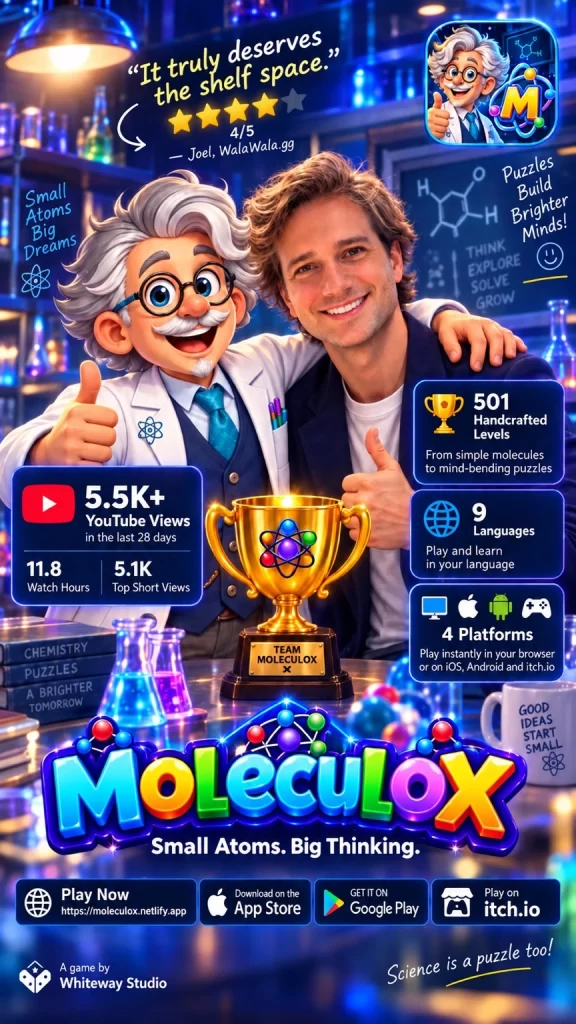
Created independently by Whiteway Studio founder Orhan Akyol, Moleculox turns real molecules into sliding logic puzzles. Atoms continue moving until something stops them, meaning players need to think several steps ahead as they try to recreate the target structure with as few wasted moves as possible. It is a simple idea on the surface, but one Orhan has already stretched across hundreds of handcrafted experiments, alongside daily challenges, rankings, multiplayer duels and increasingly complicated mechanics.
And he is nowhere near finished.
The campaign has already grown to 501 handcrafted levels, with plans to push that number towards 801, while work is also underway on new mechanics and a dedicated PC release for Steam. All of this is being developed by Orhan himself, making Moleculox as much a story about the realities of solo indie development as it is about chemistry.
We caught up with Orhan to talk about where the idea came from, how you manually design hundreds of puzzles without losing your mind, the challenge of growing a game alone, and exactly what role modern development tools, including generative AI, have played in the process.
Before we get into Moleculox itself, could you introduce yourself and tell us a little about your background? How did Whiteway Studio come about, and what eventually led you towards becoming a solo game developer?
My name is Orhan Akyol, and I’m the founder of Whiteway Studio and the solo developer of Moleculox.
The name Whiteway actually comes directly from my surname. In Turkish, “Ak” means white and “yol” means way or road, so Akyol became Whiteway.
My professional background is not in the games industry. I have spent many years working in aviation, so game development was never the obvious career path for me. But the idea of creating games has been somewhere in my mind since childhood.
I think almost everybody who grows up playing games has thoughts like, “Why didn’t they make this part differently?”, “What if there was a game like this?” or “Wouldn’t this be better if they added that?”
I was exactly the same.
I am a child of the 1980s, and I was lucky enough to experience the games of the 1990s at a very special time. Technology was limited compared with today, but our imagination was not.
When a game could not show you everything, your imagination filled in the gaps. I think that stayed with me.
For many years, however, having an idea and actually being able to build it were two very different things. Life, work and technology created very real limits.
Today, technology has changed enormously. Development tools are more accessible, and AI can help somebody like me understand areas they have never worked in before, solve technical problems and turn an idea into something testable much faster.
That does not mean game development suddenly becomes easy. I learned that very quickly! But it reduces the distance between imagination and execution.
Moleculox was born from that combination: ideas I had carried since childhood, my love of older puzzle games, and finally having tools that made it possible for one person to attempt something ambitious.
At first, I was trying to make one level. Then I made ten. Then I thought, “Why not one hundred?” Eventually that became 501 handcrafted levels, with the game now expanding toward 801, alongside new mechanics, online systems and a dedicated PC version.
I am also quite stubborn when something does not feel right. If I make a level and I am not satisfied, I rebuild it. Sometimes again and again. If you saw the very first Moleculox, you might run away from it! It has changed enormously.
My colleagues at work were also a huge source of encouragement. When I first explained the idea, they told me I should actually try making it. I even discussed the idea with AI at the beginning, and, as AI tends to do, it basically told me, “Yes, Orhan, you can do this. Great idea!” I do not think either of us realised how big it was going to become. There have been exhausting moments, frustrating moments and many things I had to learn from zero.
As the game grew, I began contacting people working in chemistry, biochemistry and molecular science, including university professors around the world. Some of these people had absolutely no reason to answer an unknown solo developer, but they did. They gave me advice, asked difficult questions, encouraged me, and sometimes simply told me they liked what I was trying to do.
The same happened with people in the games industry. Even publishers who could not take on another project sometimes took the time to reply.
When you work alone, those small moments can give you a surprising amount of confidence.
Whiteway Studio really grew from all of that. I did not begin with a company, a team and a huge business plan. I began with an idea and finally decided to see how far I could take it.
Chemistry is not the most obvious starting point for a puzzle game. Where did the original idea for Moleculox come from, and did the science inspire the sliding mechanic, or did you have the puzzle concept first and realise chemistry fitted it?
The original inspiration came from Atomix. What attracted me to Atomix was how deceptively simple it looked. On the surface, the rule was easy to understand: move the atoms and construct the molecule. But once you started playing, even a small puzzle could require several very precise and intelligent moves. I loved that contrast.
I like games where you understand the basic idea almost immediately, but mastering it takes much longer.
When I started thinking about Moleculox, one of my goals was to make that kind of experience faster, more accessible and more natural for a modern player. I wanted somebody to look at the board, understand what they were supposed to do and start experimenting without needing a huge explanation.
But I also never wanted Moleculox simply to become a recreation of Atomix. I wanted to take the elegance of that sliding mechanic and build a much larger puzzle language around it. That is why Moleculox gradually gained more mechanics, obstacles, interactions and different ways of manipulating atoms.
The chemistry theme also gives the player a purpose. You are not simply moving coloured objects around a board. You are trying to build something. That made molecules feel like a very natural fit.
For me, a good puzzle should not be difficult because the rules are confusing. The rules should be clear. The solution should be clever.
That is the part of Atomix that inspired me most, and it is the part I tried to carry into Moleculox while creating something much larger and more modern.
You are using molecules inspired by real chemistry, but Moleculox also needs to work first and foremost as an enjoyable puzzle game. How do you balance scientific accuracy with the need to create levels that are readable, satisfying and fun?
For me, the balance begins with one very simple question: If I am not enjoying the game myself, why should I expect somebody else to enjoy it?
I never wanted to create Moleculox just so I could say, “I made a game about molecules”.
If every level was simply another molecule assembled in almost exactly the same way, most players would probably play five or ten levels and become bored.
That is why mechanical variety became extremely important. At one stage I had ideas for around forty mechanics. But more is not automatically better. If several mechanics create almost exactly the same experience, they begin to weaken the game rather than strengthen it. So I reduced and refined them into roughly 27 mechanics that I felt could genuinely change the way a player thinks.
The reaction I want after completing a level is: “What is going to happen in the next one?”
Real chemistry creates another challenge. Real molecular structures do not always translate perfectly into a readable sliding puzzle. Sometimes the real geometry, bonding behaviour or number of connections simply does not work naturally on a board. When that happens, I try to stay as close to the real science as possible while protecting the puzzle.
I began the project without advanced chemistry knowledge myself, and the game forced me to learn. Suddenly I was asking questions such as: how many bonds can this atom form? Where would another atom normally connect? How close does my representation need to be?
That eventually led me to scientists and professors who helped me understand those questions much better. Sometimes they did not simply give me an answer. They asked another question that forced me to go away and research the molecule properly. I loved that.
Moleculox was making me learn while I was making the game.
But I always have to ask one other question: If I reproduce this scientific detail perfectly, does it make the puzzle better, or does it simply make the experience harder to understand?
I do not want scientific accuracy to become a punishment. Moleculox is still a game first. That is also one reason Dr Edward Atom is important. He is not only there to explain game mechanics. He can also give players small pieces of scientific information along the way. The player does not need to stop everything and study a textbook. The science can appear naturally.
Somebody may play because they enjoy chemistry. Somebody else may only want difficult puzzles. Another person may enjoy the story or the competitive side.
I want all of those players to have a reason to stay.
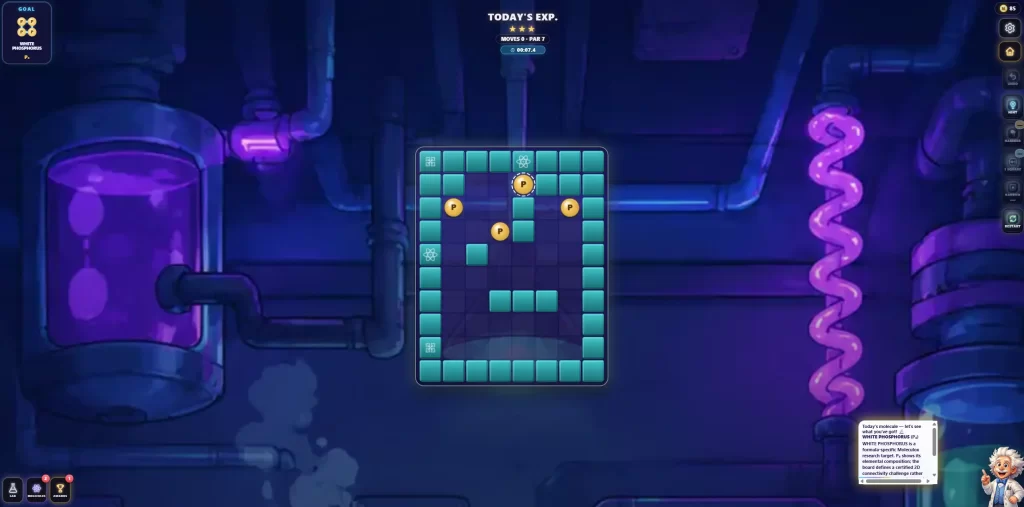
The central rule sounds wonderfully simple: atoms keep sliding until they hit something. Simple rules can often create surprisingly complicated puzzles, though. How much experimentation did it take to find that core mechanic, and when did you realise it had enough depth to support an entire game?
The basic sliding rule was simple from the beginning. But I did not immediately realise how far it could go.
A major turning point came from letting friends and colleagues play early versions. They would say things like, “What if this part rotated?”, “What if these two things connected?”, or “Could the player do this?” Those questions changed the way I looked at Moleculox.
I realised people did not only want to slide atoms into position. They wanted to interact with the board, discover systems and experiment. That was when the game stopped being only “move the atoms and build the molecule” in my mind.
The player is actually solving two problems at the same time. They need to understand how to create the target molecule, but they also have to understand the board itself. What does each mechanic do? How do different mechanics interact? How can I use them to move the atoms where I need them?
That second layer created much more depth. A mechanic may be easy when you see it alone. Another mechanic may also be simple. Put them together and suddenly the player has a completely different problem. That was when I realised the concept could support hundreds of puzzles.
In a playful way, I sometimes think Moleculox is asking the player one question: “Are you smart? Prove it”. Not because I want the game to make anybody feel stupid. Quite the opposite.
I want that moment where the player suddenly sees the solution and thinks, “Of course! How did I not see that?” That feeling is one of the best things a puzzle game can create.
Moleculox now contains 501 handcrafted levels, and you are working towards 801. That is an enormous number for one person to design manually. What does your actual level-design process look like, and how do you know when a puzzle is genuinely interesting rather than simply difficult?
I usually begin with the mechanics and the board rather than the molecule itself.
The first question I ask is: what is different about this level?
The formula is still important because I do not want the player to enter another level and think, “Isn’t this basically the same puzzle I just played?” I want them to think, “Okay. New molecule. What is this board going to do to me now?”
There have been many times when friends reached one of the later puzzles and said, “What kind of level is this? You are driving us crazy”. Sometimes that made me question myself. Did I push too far? Did I make a bad puzzle?
Then they solved it.
And very often the same person would come back and say, “That was an amazing level. Make more like that”. That taught me something. Completing a very easy puzzle gives you a small sense of satisfaction. But struggling with something, changing your approach several times and finally discovering the solution can create a much stronger feeling.
In some later Moleculox levels, I want the player to finish and think, “What did I just go through?” Or: “How did I actually solve that?” Of course, difficulty alone is not enough. Making something frustrating is easy. Making something difficult that still feels fair and rewarding is much harder.
I have even had friends message me late at night while stuck on a puzzle and basically blame me for destroying their evening. Then, after solving it, they message again to tell me how much they loved the level. Those are some of my favourite reactions.
I also throw away a lot. There are levels, mechanics and ideas players will never see. If something is technically solvable but repetitive, boring or unfair, I would rather delete it than keep it just to increase the level count.
For me, “handcrafted” does not simply mean I placed the walls and atoms manually. It means every level should have a reason to exist.
After hundreds of levels, how do you stop yourself repeating the same ideas? Is expanding the game now primarily about introducing new mechanics and obstacles that completely change how players have to think?
Repetition is one of the things I am most sensitive about. I do not want someone to feel, “I already played this level. Only the molecule changed”. If an idea does not make the game better, it does not belong in Moleculox.
I originally had around forty mechanical ideas. I did not keep them all. Some were too similar. Some were not interesting enough. Some simply did not create the experience I wanted.
I also realised that constantly inventing a completely new mechanic is not necessarily the answer. The real depth often comes from combining the mechanics that already exist. Something simple can become completely different when mixed with two or three other systems. Especially in the later campaign, I do not want mechanics appearing as isolated demonstrations. I want them interacting with each other.
I want the player to open a level, look at the board for a moment and think, “Wait… what has he done here?” That reaction makes me very happy.
I also take the player’s time seriously. If somebody gives me twenty minutes, one hour or many hours of their life, I do not want to fill that time with content that exists only to increase a number. If I take their time, I owe them something enjoyable in return.
In the future, I would love somebody to see my name on another game and think, “Orhan made this? Then it is probably worth trying”.
That kind of trust is very important to me. I do not want to fool people with weak content.
Later in Moleculox, I hope there are levels that make players stop for a second, smile and say, “What has he done this time?” That smile is exactly what I am designing for.
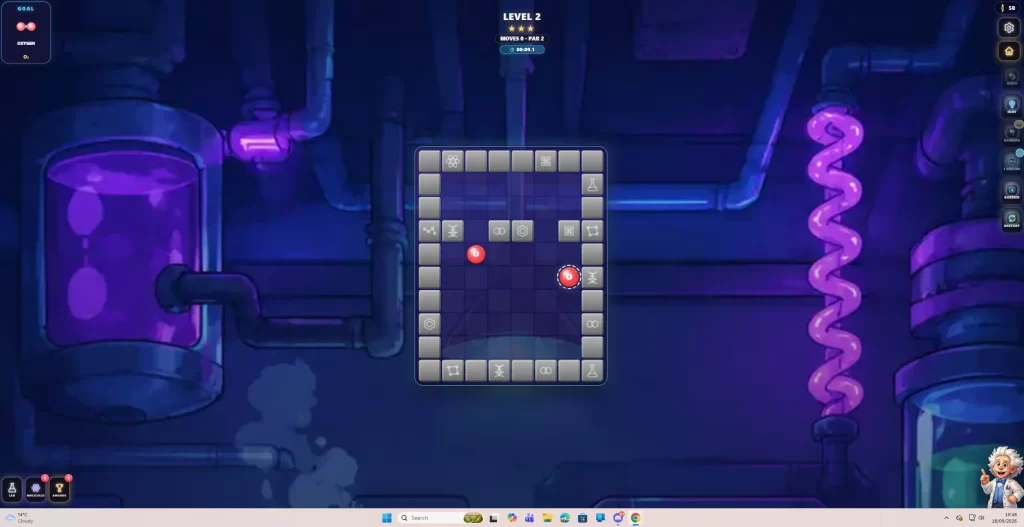
There is also an interesting difficulty problem here. Someone with a chemistry background may recognise molecules immediately, while another player might barely remember the periodic table from school. How do you make Moleculox approachable without stripping away the scientific identity that makes it distinctive?
Absolutely. You do not need to know chemistry to play Moleculox. That was important from the beginning. I do not want the game testing whether somebody remembers the periodic table from school.
The early levels should give the player confidence very quickly. I want them thinking, “Okay, I understand this. I can do it”. Then gradually the questions change.
Instead of wondering what a chemical formula means, the player starts thinking, “Which atom should I move first?”, “Should I use this path now?”, or “If I move this one here, will I block another one?”
At that point, chemistry has stopped feeling like a school subject and has become part of the puzzle language.
Speaking with professors was actually very useful for me here. Some of them asked questions that made me realise how much I still did not know. And I thought: there will be many players exactly like me. They may know H₂O, but beyond that they may know very little. That should never exclude them from the game. The science should create curiosity, not anxiety.
If somebody finishes a level and later realises, “Oh, that is a real molecule”, that is already something. If Dr Edward gives them a fact and they become curious enough to learn more, even better. But none of that should be required to enjoy the puzzle. I never want Moleculox to feel like a chemistry exam.
Beyond the main campaign, you have daily experiments, scoring, rankings and multiplayer duels. Was Moleculox originally intended to become this broad, or did those more competitive and replayable elements emerge once you saw how people interacted with the core puzzles?
Not at all. Honestly, I never imagined Moleculox would become this large. At first I was simply trying to make the core puzzle work. Then people started playing and saying, “You should add this”, or “Wouldn’t it be better if you could do that?”
For a while the project grew so quickly that I remember thinking, “What am I doing? Am I controlling this game, or is this game controlling me?”
I am also a bit of a perfectionist, and unfortunately I am not very good at simply saying, “No, that cannot be done”. If somebody suggests something interesting, my brain normally starts asking, “How could I make that work?
That creates a lot more work for me! But it also shaped Moleculox.
Someone wanted to compare scores. That naturally pushed me toward rankings and competitive systems. Then I thought: if somebody can play offline, why should there not also be online reasons to return?
When I created a How to Play section, I realised players also needed help inside the game. That made Dr Edward more important.
Then I thought: if we are using real molecules and science, why not create a Moleculopedia?
One feature kept revealing the need for another.
The game did not grow from one enormous design document I wrote before development. It grew from watching people play, listening and reacting.
Even now, people around me keep saying, “Do not stop. Keep going”. When you are developing alone, hearing that is a huge source of motivation.
Multiplayer seems particularly unusual for this kind of game. What does competition add to something that might otherwise be quite a thoughtful, solitary experience, and have players surprised you with how seriously they approach optimising solutions?
One of my favourite things is actually seeing players try to communicate.
Players currently have limited predefined messages, so sometimes somebody contacts me and says, “Tell that player to keep following me!” because they cannot fully explain it directly. I find that hilarious. Two people who have never met are trying to communicate through me because they met inside Moleculox. I love that.
It also made me realise that I do not want players only competing. I would love them to help each other too. In the future, I would like players to be able to support other players, perhaps through Molecoin, sharing solutions or eventually creating laboratory groups that can cooperate and compete. Maybe one day that will happen.
At the speed this game keeps growing, I have learned not to rule things out.
Competition is still important. When you solve a puzzle alone, you know you did well. Multiplayer lets you prove it against somebody else. And it is not only one number. Time matters. Score matters. Stars matter. Efficiency matters. Rewards such as Molecoin matter.
So the question changes from “Can I solve this?” to “Can I solve this better than the other person?”
There are three different multiplayer approaches: two people can compete on the same device, players can create a private room on separate devices, or they can face a random opponent from somewhere in the world. I like the idea that a person in one country can suddenly be solving the exact same puzzle against somebody they have never met on the other side of the world.
Someone originally asks me for one small feature. My problem is that I sometimes give them five. That is probably why Moleculox keeps growing.
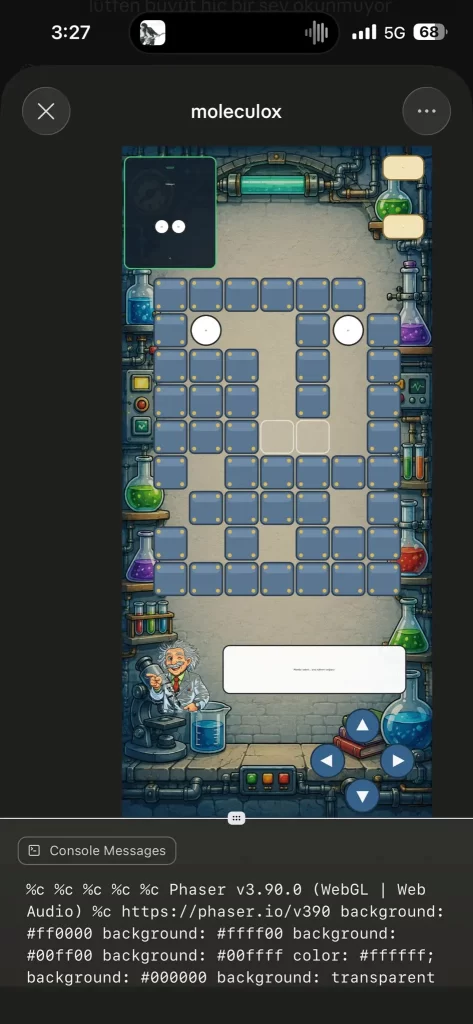
Moleculox has already appeared across browser and mobile platforms, with a PC/Steam version now on the way. What do you want the Steam edition to offer beyond simply putting the existing game on another storefront?
An important turning point actually came from outside feedback. WalaWala Games reviewed Moleculox, and one of the points that stayed with me was their view that this kind of game should also be on Steam. That made me stop and think. Until then, I had mainly been looking at Moleculox as a mobile and browser experience.
Then I started asking myself: why should it stop there?
As Moleculox became larger and the later puzzles became more complex, I began to feel that many of those boards could be especially enjoyable on a large screen. There are puzzles where you need time to study what is happening, understand several mechanics at once and plan multiple moves ahead. So I do not want the Steam version simply to be a mobile game stretched across a monitor. I want it to feel as if it belongs on PC.
The interface is being adapted for landscape displays, board readability becomes more important, controls need to feel natural, and the campaign itself continues to grow alongside the PC work.
But there is also a simpler reason. I want Moleculox to reach people wherever they like to play. Some people want a quick puzzle on their phone. Others want to sit in front of a larger screen and spend much longer studying something difficult. One does not need to replace the other.
Sometimes one sentence from somebody outside a project can make you look at your own work differently. For me, the question “Why isn’t this on Steam?” did exactly that.
You mentioned that Moleculox is still actively evolving. What have players taught you so far? Has there been any feedback that made you rethink a mechanic, change your difficulty curve or realise people were playing the game in a way you had never anticipated?
Moleculox is still changing constantly. Honestly, I do not even know how many times the game has changed. When an idea comes into my head, I write it down immediately. Sometimes it becomes a mechanic. Sometimes it becomes a level. Sometimes it changes something that already exists.
If you saw the first Moleculox and the current game side by side, you might not believe they were the same project. One thing players really changed for me was the way I think about difficulty. There is a point where Moleculox becomes genuinely hard. Especially around levels 460 to 501, there are puzzles designed to make your brain hurt a little.
At first, I wondered whether I had pushed things too far. Then something unexpected happened. The players who reached those levels were not asking me to make them easier. Some were asking me, “Is that the hardest you have?” My reaction was basically: just wait.
I have received thank-you messages about difficult levels. That surprised me.
At the beginning of the game, somebody may think, “Oh, this is easy”. But as they learn the mechanics and become better, their expectations change. They start wanting puzzles that test everything they have learned. So I realised my job is not simply to prevent frustration. The more interesting challenge is turning frustration into determination.
The game should become harder, but the player should also feel themselves becoming better. When that happens, instead of fearing the next difficult level, they start asking for it. That is a wonderful compliment for a puzzle designer.
You are handling this independently, which means level design is only one part of the job alongside programming, visuals, testing, marketing, community management and everything else. What has solo development taught you about the difference between making a game and actually trying to build an audience around one?
Solo development taught me that making the game is only half the job. You can spend thousands of hours creating something you believe in, but if nobody knows it exists, it can remain completely invisible.
There was one day when I sent 876 outreach emails. That is not an exaggeration.
University professors, scientists, publishers, YouTubers, streamers, reviewers, people who have worked in games for many years, well-known names — I contacted almost everybody I thought might be willing to look.
Why? Because I kept thinking: I made this game. Somehow I have to get somebody to see it.
If Moleculox existed on a CD instead of digitally, sometimes I think I would probably be walking from door to door with it.
Of course, most messages do not become something. People are busy. Publishers already have full schedules. Some people never answer. And then somebody does.
A professor on the other side of the world replies to somebody they have never met. A publisher takes a moment to explain what they think. A reviewer plays the game. Or people like Josh and the Indie-cent Exposure team answer sincerely and say, “Let’s talk about your game”.
Those moments mean a lot when you are working alone.
And that is why I am genuinely grateful for this Q&A. You did exactly what I hoped somebody would do when I sent all of those messages. You stopped for a moment, looked at Moleculox and gave an independent developer the opportunity to explain what he was trying to build.
Solo development taught me that there are really two different challenges: make something worth playing, then convince somebody to give it a chance.
And strangely, trying to build an audience also improved the game. Some people gave me visibility. Some gave me scientific advice. Some gave me design ideas. Some challenged things I believed. Some encouraged me exactly when I needed it.
So for me, building an audience stopped being separate from development. It became part of development. If I had quietly made Moleculox and waited for the world to discover it, we probably would not be having this conversation now.
I also want to ask directly about the tools behind the project, because some of Moleculox’s imagery has a visual style that may lead people to wonder about generative AI. Rather than make assumptions, can you clarify whether generative AI has been used anywhere in Moleculox, whether for artwork, writing, localisation, code, marketing material or any other part of development?
Yes. And I would rather be completely open about that than pretend otherwise. AI has been a genuine development assistant for me. When you work alone, there are many times when you know exactly what you want to create, but you do not know the technical path to reach it.
AI has helped me research unfamiliar areas, understand technical problems, assist with code, explore approaches, work with text and other development tasks, and turn ideas into prototypes much faster. It also does something surprisingly important for somebody working alone: it keeps the conversation going.
When you are sitting there late at night trying to fix the same problem for the tenth time, having something basically telling you, “You can do it, my friend. Keep going!” can genuinely help.
AI is very good at giving you confidence. Sometimes maybe too good! But there is one distinction that is extremely important to me. AI did not decide what Moleculox should become. I did. The mechanics, the direction, what stays, what gets removed, the experience I want players to have, and the final decisions are mine. I give the direction. I test things. I reject things. I change things.
AI helps me get there faster. If I had tried to build a traditional studio from the beginning, I honestly do not know whether Moleculox would already be in players’ hands.
A proper studio costs money. Finding specialists takes time. And talented people deserve to be paid properly. Those realities can stop an independent idea before it ever becomes a real project. AI lowered that barrier for me. It allowed me to learn while building. I do not see AI as the creator of Moleculox. I see it as my assistant.
It can suggest, explain, troubleshoot and accelerate. But somebody still has to know what they are trying to create, recognise when something is bad and take responsibility for the result. That responsibility is mine.
Generative AI has become an increasingly divisive subject among indie developers, particularly around artwork, training data and the impact on working artists. Regardless of whether you use it yourself, what is your own position on these tools, and where would you personally draw the line between useful development assistance and replacing creative work?
I understand why generative AI makes some people uncomfortable, especially artists and developers whose work may be affected by it. I have received negative feedback myself on some forums and websites, and I do not dismiss those concerns. People have a right to ask those questions.
But my personal view is that human imagination is still incredibly powerful. People dream. People feel. People create connections between ideas because of their own lives and experiences.
AI can give you suggestions. It can surprise you. Sometimes it can even produce something beyond what you originally imagined, and that can be amazing. But it still needs direction.
There have been many times when AI gave me something completely different from what I wanted. I have probably argued with my AI assistant more than I should admit.
When it does not understand me, sometimes I have to stop, calm down and explain the same thing in a completely different way. That also teaches you something: the tool does not automatically understand what exists inside your head.
For me, the line is about authorship and responsibility. I do not want AI deciding what I should create. I want to decide what I am creating and use technology to help me reach it.
If I had a huge budget and access to an amazing team of specialists, of course I would value working with talented artists, programmers, writers and designers. AI does not make those people unimportant. Human interpretation and personality have enormous value.
But for somebody like me, who came from a completely different professional world, AI opened a door. Without that assistance, I honestly do not know whether Moleculox in its current form would exist.
So I see AI primarily as an opportunity. Not as the person creating the dream. More like another tool helping somebody who already has the dream.
AI can help me build the road. But I still have to decide where that road is going.
Finally, if we speak again after those 801 levels are finished and Moleculox has established itself on PC as well, what would make you feel the project had genuinely succeeded? Is it player numbers, building a lasting community, teaching people something about chemistry, or simply proving that an unusual idea from one developer could find its audience?
I do not think I can say, “I have succeeded”. Not yet.
I am proud of how far Moleculox has come, especially when I look at the very first version. If you put the first Moleculox next to the game today, the difference probably says more than I can explain.
And that is something I would like other people who dream about creating something alone to understand. Do not be afraid to start badly. Start somewhere.
The thing you cannot do today may be something you understand tomorrow. The thing that looks terrible today may look completely different after another week, another month or another hundred attempts. You do not need your first version to be beautiful. You need it to exist.
That is exactly what happened with Moleculox. I improved one thing, then another, then another. Eventually I looked back and realised the thing in front of me was no longer the thing I had started with.
So what would success mean?
Player numbers would be wonderful. A strong community would be wonderful. Watching people compete around the world would be wonderful. If somebody learned something about chemistry because of Moleculox, that would make me extremely happy.
And yes, I would love to see Moleculox recognised at a game awards event one day. I would be lying if I said that would not mean a lot to me. But there is something even more important underneath all of that. I want Moleculox to show that an idea does not have to come from a huge studio to deserve a chance.
There are many people like me who have ideas sitting quietly in the back of their minds. Maybe they have a completely different career. Maybe they do not know professional game development. Maybe they do not have a large budget or a team.
If I, Orhan Akyol, coming from outside the traditional games industry, could bring an idea this far, then perhaps my journey can give even a little confidence to somebody else standing at the beginning of theirs.
Do not wait until you feel completely ready. Start. Put your imagination into motion.
Not everybody will like what you make. Some people will criticise it. Some will not understand it. Some will simply say, “This is not for me”. That is normal.
You do not need everybody to love what you create.
But I also do not believe in making something only so you can say that you made something. Create something you genuinely like yourself. Make the game you would want to play.
Because if you truly care about what you are creating, somewhere in the world there will be other people who feel the same way.
Maybe it begins with one person. Then ten. Then a hundred. That is how Moleculox began.
And if the journey of Moleculox helps even one other person take that first step, then I think I will already have achieved something meaningful. But I am not finished.
Moleculox is moving toward 801 levels. The PC journey is beginning. I want to build a lasting community. I want to keep learning from players and scientists. And I hope one day Moleculox can win a meaningful award. Moleculox is also not the end of Whiteway Studio. Before Moleculox, I already had three other game ideas in my mind, and one day I want to bring those to life too.
My promise to players is simple: I do not want to release something just because I can release it. If my name is attached to something, I want to believe that it deserves the player’s time.
So I will keep learning. I will keep rebuilding. And I will keep moving forward. To anybody who has an idea but is afraid to begin: do not be afraid. Make the thing you wish existed.
I’m Orhan Akyol — and may the Force be with you, my friends. 🙂
A big thank you to Orhan Akyol for taking the time to speak with us about Moleculox.
There is something particularly fitting about a chemistry-inspired game continuing to grow by adding new elements to the mixture. What began with the straightforward idea of sliding atoms into place has expanded into hundreds of handcrafted puzzles, competitive modes, daily challenges and now another major push towards PC.
Doing all of that alone makes the scale of the project considerably more impressive, but it also highlights one of the realities facing independent developers. Making the thing is only half the battle. Getting anyone to notice it when thousands of other games are fighting for the same attention can be every bit as challenging.
Moleculox at least has one useful thing working in its favour: it is easy to explain, but considerably harder to master.
And if Orhan really does make it all the way to 801 handcrafted experiments, we suspect he will know considerably more about moving atoms around than any one person reasonably should.
Where to play Moleculox
- Website: https://moleculox.netlify.app
- App Store: https://apps.apple.com/app/moleculox/id6793295658
- Google Play: https://play.google.com/store/apps/details?id=com.whitewaystudio.moleculox
- itch.io: https://whitewayhan.itch.io/moleculox
Thanks for checking out this interview. If you want to see which other developers we’ve been chatting to, just click right here.